Status: MainstreamVerdict: Supported by measurements
The claim: The overall strength of Earth's magnetic field has been falling since direct measurements began in the 1800s.
Why this label: Ground observatories since the 1830s and ESA's Swarm satellites agree: Earth's overall magnetic field has weakened by about 9% to 10% over the last 200 years. At the same time, fossil magnetic records show the field is still twice as strong as its million-year average.
Background
Earth's magnetic shield is generated by churning liquid iron in the outer core, about 1,800 miles (3,000 km) beneath our feet. Because that molten iron flows like weather in an ocean, the magnetic field is always changing. Since Carl Friedrich Gauss first measured the field's strength in the 1830s, the main two-pole (dipole) part has dropped by roughly 9–10%. What that means for a future pole flip is covered in Is a geomagnetic reversal overdue or imminent?.
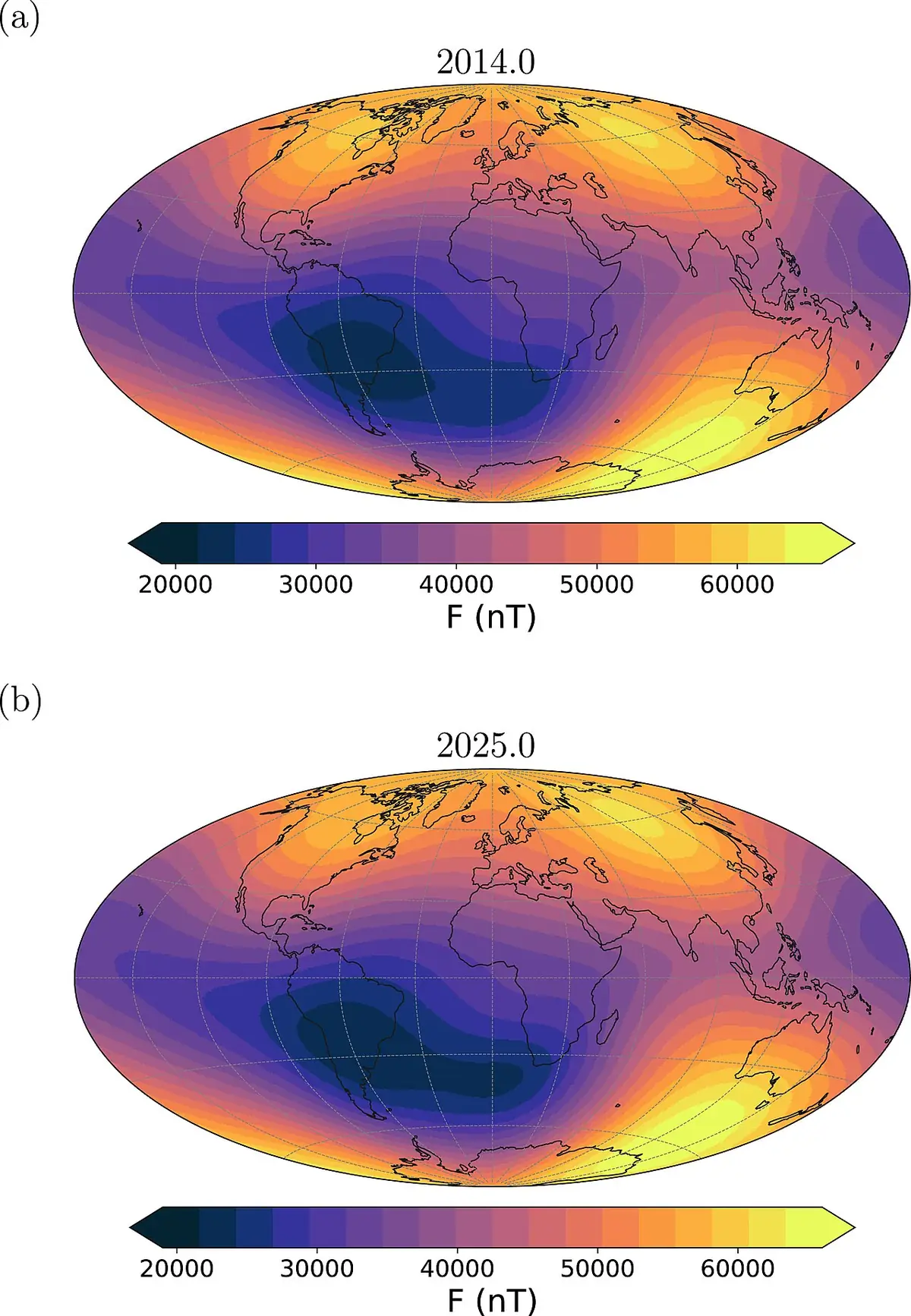
Field strength at Earth's surface in 2014 and 2025, from ESA's Swarm satellites (Finlay, Kloss and Gillet). Image: C.C. Finlay, C. Kloss, N. Gillet, CC BY 4.0, via Wikimedia Commons. Resized.
✓ Evidence and arguments for
ESA Swarm satellite measurements (9% drop). The European Space Agency reports that Earth's global magnetic field has lost about 9% of its strength over the past 200 years. [1]
NASA global average (9% weaker). NASA confirms the same 9% global drop over the past two centuries. [2]
USGS ground-station record (10% drop since the 1830s). The US Geological Survey states that average surface magnetic strength has fallen by about 10% since magnetometers were invented in the 1830s. [3]
Steady 5%-per-century pace. Brown et al. (2018) measured a decline of about 5% per century since 1840. [4]
Growing weak spot in the South Atlantic. Eleven years of Swarm satellite data (2014–2025) show the weak-field region over the South Atlantic expanding and its lowest point dropping from 22,430 nT to 22,094 nT. [5]
🔬 Evidence and arguments against
Some regions are getting stronger. The decline is not uniform everywhere. Between 2014 and 2025, the strong-field patch over Siberia actually grew and strengthened by 260 nT while the Canadian patch shrank. [5]
Still twice the million-year average. NASA notes that ancient lava and sediment records show today's magnetic field is still as strong as its 100,000-year average and about twice its million-year average. [2]
Past dips often rebounded without flipping. The USGS notes that Earth's field has weakened and strengthened many times in the past without flipping over. [3]
Open questions & what would change the label
Will the current 200-year decline continue or bounce back up? Because we cannot see directly inside the liquid iron core, only ongoing satellite tracking over the coming decades will tell.
Brown, M. et al. (2018). Earth's magnetic field is probably not reversing. PNAS. doi:10.1073/pnas.1722110115critic/test
Finlay, C. C. et al. (2025). Core field changes from eleven years of Swarm satellite observations. Physics of the Earth and Planetary Interiors. doi:10.1016/j.pepi.2025.107447data
The Spinning Magnet: The Electromagnetic Force That Created the Modern World—and Could Destroy It
Alanna Mitchell · ISBN 9781101985182
Science journalist Alanna Mitchell visits the geophysicists studying Earth's molten iron core, the growing weak spot over the South Atlantic. The temporary magnetic flip 41,000 years ago. Explores what a future flip would do to satellites and power grids.
Why this book matters to both sides
Bridges both sides of the magnetic pole-shift debate by combining mainstream satellite data with an honest look at how a weak magnetic shield exposes modern technology to solar storms.
Award-winning geophysicist Ronald Merrill explains how churning liquid iron 1,800 miles underfoot creates Earth's magnetic shield. He also explains why magnetic pole flips are completely different from the solid planet tipping over.
Why this book matters to both sides
Crucial for separating the three ideas often mixed up under 'pole shift': magnetic flips in the liquid core, slow tipping of the whole planet over millions of years, and rapid crust-slip claims.
Forgotten Civilization: New Discoveries on the Solar-Induced Dark Age (Revised ed.)
Robert M. Schoch with Catherine Ulissey · ISBN 9781644112922
Boston University geologist Robert Schoch presents his water-weathering case for an older Great Sphinx alongside his Leading Edge hypothesis that giant solar outbursts around 9700 BCE melted the Ice Age glaciers.
Why this book matters to both sides
The primary Leading Edge book arguing that an extreme solar superstorm—rather than a comet impact—ended the last Ice Age and left plasma patterns in ancient rock art.
Earth's Shifting Crust: A Key to Some Basic Problems of Earth Science
Charles H. Hapgood (Foreword by Albert Einstein) · ISBN 9781015422193
Carrying a famous foreword by Albert Einstein, Charles Hapgood's 1958 book proposes that the heavy weight of off-center polar ice caps periodically pulls Earth's outer crust over the interior, shifting continents into new latitudes.
Why this book matters to both sides
The foundational book behind physical 'crustal displacement' pole-shift ideas, letting readers compare Hapgood's 1958 ice-weight argument with modern plate tectonics.
FTC affiliate disclosure: Book links above go to Bookshop.org (Affiliate ID 130218, shop Search for the Truth), which supports independent bookstores. If you buy through one of these links, Solar Evidence earns a 10% commission at no extra cost to you. All affiliate links carry rel="sponsored nofollow noopener". Every recommended title is verified in print and meets our 4.3+/5 reader or landmark scholarly reputation standard; commissions never influence our evidence labels. Affiliate policy.
Interest signal: Wikipedia 'Earth's magnetic field' averaged 17,192 views/month (Oct 2025-Sep 2026). Sources were checked against Crossref/publisher pages on 2026-10-22. Labels describe the claim, not the people who hold it. Disclaimer.