Educational reference only—not for operational or safety decisions. For official alerts use NOAA SWPC.
Claims › The Sun & space weather › How strong would Solar Cycle 25 be? The prediction debate
How strong would Solar Cycle 25 be? The prediction debate
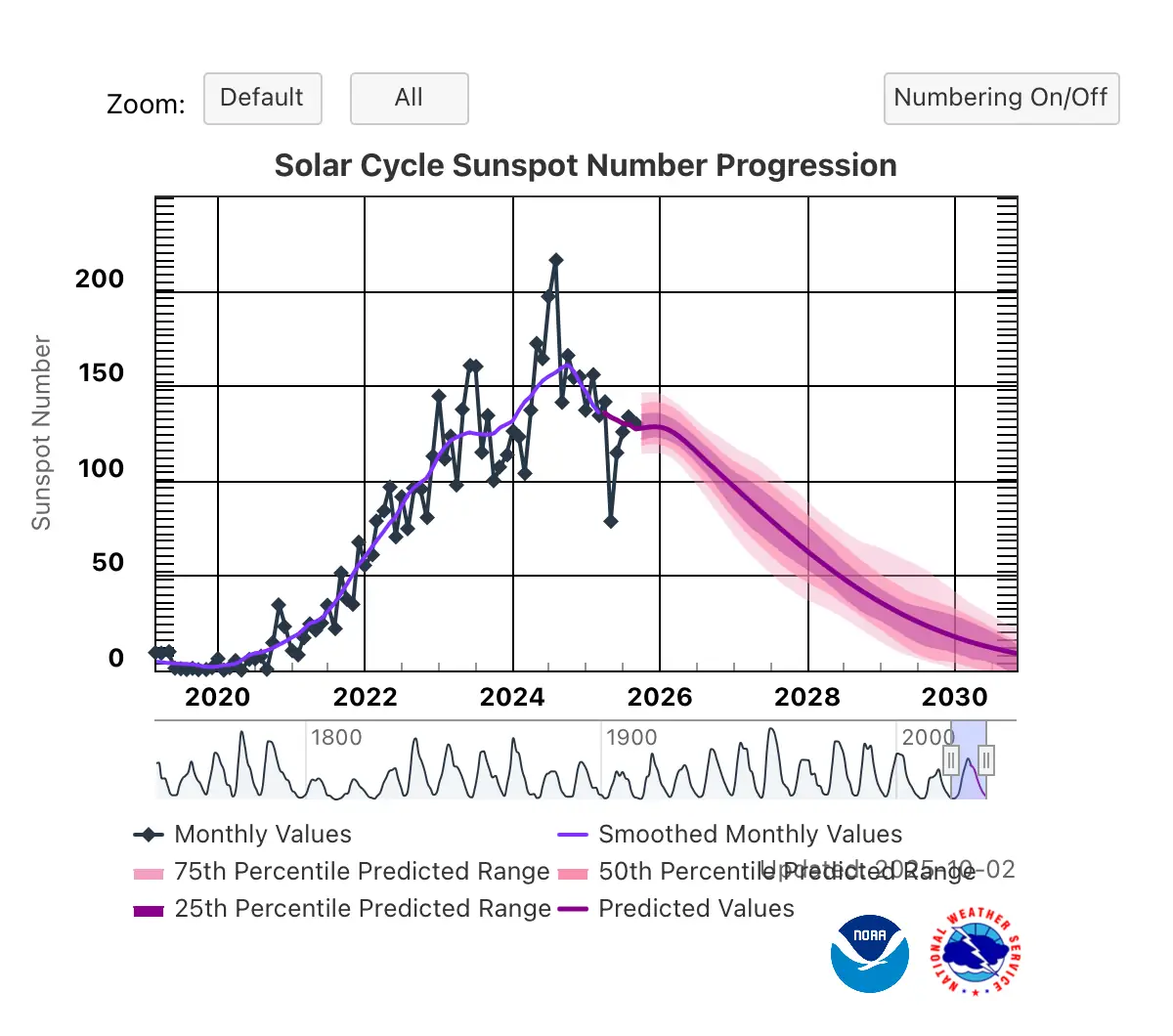
Status: ContestedVerdict: Measured: Cycle 25 peaked above the 2019 panel forecast (160.9 vs. 115) but below record highs; which prediction model works best remains Contested
The claim: Solar Cycle 25 would be a weak cycle similar to Cycle 24 (the 2019 NOAA/NASA/ISES panel consensus). A competing 'terminator' method argued it could be one of the strongest on record.
Why this label: The real Sun settled the first half of this debate. Solar Cycle 25 peaked at a smoothed sunspot number of 160.9 (2024-10). That beat the official 2019 panel forecast of 105–125, while staying well below the all-time record of 285.0 (1958-03). Which forecasting method works best remains Contested.
Background
Predicting how strong an 11-year sunspot cycle will be is one of solar physics' toughest challenges. In 2019, an official NOAA/NASA panel combined nearly 50 forecasts and predicted a mild cycle peaking at 115 in July 2025. Meanwhile, a rival 'terminator' timing method by McIntosh and colleagues predicted a much stronger cycle. By 2024, the real Sun rose well above the panel's forecast, prompting NOAA to update its outlook.
NOAA's chart of observed Cycle 25 sunspot numbers against the official prediction. Image: NOAA, Public domain, via Wikimedia Commons. Resized.
✓ Evidence and arguments for
The 2019 official consensus. The international panel predicted a mild peak of 115 sunspots (range 105–125), similar to weak Cycle 24. [1][2]
Polar magnetic field models. Surface flux-transport models (Upton & Hathaway 2018) used the strength of the Sun's polar fields at solar minimum and also predicted a mild cycle. [3]
The 'terminator' challenger. McIntosh and colleagues (2020) tracked the exact date when the old cycle's magnetic bands vanished ('the terminator') and predicted Cycle 25 would be much stronger than the consensus. [4]
🔬 Evidence and arguments against
The Sun beat the 2019 panel. NOAA's smoothed sunspot number reached 160.9 in 2024-10, beating Cycle 24's peak of 116.4 (2014-04) and topping the panel's 105–125 range. [5]
NOAA's 2023 upward revision. In 2023, NOAA updated its live forecast to a peak of 137–173 sunspots in 2024, matching what actually happened. [6]
Below the all-time record. While Cycle 25 was strong, it stayed well below the record smoothed peak of 285.0 (1958-03), so the highest 'top-tier record cycle' predictions also overshot. [5]
Solar maximum reached in 2024. On October 15, 2024, NASA and NOAA announced that the Sun had entered its maximum phase. [7]
Open questions & what would change the label
Does the terminator timing method capture a deeper magnetic clock inside the Sun? The upcoming forecast for Solar Cycle 26 (expected to start around 2029–2032) will be the next head-to-head test.
Upton, L. A. & Hathaway, D. H. (2018). An Updated Solar Cycle 25 Prediction With AFT: The Modern Minimum. Geophysical Research Letters. doi:10.1029/2018GL078387forecast
McIntosh, S. W. et al. (2020). Overlapping Magnetic Activity Cycles and the Sunspot Number: Forecasting Sunspot Cycle 25 Amplitude. Solar Physics. doi:10.1007/s11207-020-01723-yforecast
Nearest Star: The Surprising Science of Our Sun (2nd ed.)
Leon Golub & Jay M. Pasachoff · ISBN 9781107672642
A clear, readable tour of how the Sun works from the inside out. Two veteran solar astronomers explain core nuclear fusion, the 11-year sunspot cycle, solar flares, and billion-ton coronal mass ejections.
Why this book matters to both sides
Gives the standard physics baseline for how the Sun generates heat and magnetic storms. That you can compare against alternative Electric Sun and superflare ideas.
Joanna D. Haigh & Peter Cargill · ISBN 9780691153841
Two physicists explain how much the Sun's brightness and ultraviolet rays actually change over the 11-year sunspot cycle. They also test how much quiet-Sun periods (like the 1600s Maunder Minimum) cool Earth's climate.
Why this book matters to both sides
Directly addresses the 'Grand Solar Minimum / Mini Ice Age' debate using satellite measurements of solar output and upper-air winds.
The Sun Kings: The Unexpected Tragedy of Richard Carrington and the Tale of How Modern Astronomy Began
Stuart Clark · ISBN 9780691141268
On September 1, 1859, British astronomer Richard Carrington saw a bright white flash on the Sun. Hours later, the biggest solar storm in modern history sparked telegraph lines and lit up red auroras over the tropics.
Why this book matters to both sides
Sets the real-world benchmark for a worst-case solar superstorm (the 1859 Carrington Event). Both modern power-grid engineers and solar-catastrophe writers measure their models against this storm.
Forgotten Civilization: New Discoveries on the Solar-Induced Dark Age (Revised ed.)
Robert M. Schoch with Catherine Ulissey · ISBN 9781644112922
Boston University geologist Robert Schoch presents his water-weathering case for an older Great Sphinx alongside his Leading Edge hypothesis that giant solar outbursts around 9700 BCE melted the Ice Age glaciers.
Why this book matters to both sides
The primary Leading Edge book arguing that an extreme solar superstorm—rather than a comet impact—ended the last Ice Age and left plasma patterns in ancient rock art.
FTC affiliate disclosure: Book links above go to Bookshop.org (Affiliate ID 130218, shop Search for the Truth), which supports independent bookstores. If you buy through one of these links, Solar Evidence earns a 10% commission at no extra cost to you. All affiliate links carry rel="sponsored nofollow noopener". Every recommended title is verified in print and meets our 4.3+/5 reader or landmark scholarly reputation standard; commissions never influence our evidence labels. Affiliate policy.
Interest signal: Wikipedia 'Solar cycle 25' averaged 5,257 views/month and 'Solar cycle' 9,050 (Oct 2025–Sep 2026). Sources were checked against Crossref/publisher pages on 2026-10-27. Labels describe the claim, not the people who hold it. Disclaimer.