Educational reference only—not for operational or safety decisions. For official alerts use NOAA SWPC.
Claims › The Sun & space weather › Will a grand solar minimum cause a 'mini ice age'?
Will a grand solar minimum cause a 'mini ice age'?
Status: Leading Edge / ContestedVerdict: Open question on future cycle amplitude; climate models measure only 0.1–0.3 °C cooling from a Maunder-like minimum
The claim: A grand solar minimum like the Maunder Minimum is coming in the next decades and will cause a 'mini ice age' that cancels out global warming.
Why this label: Two questions get mixed together here. First, could sunspots drop into a multi-decade quiet spell in the 2030s? That is a real scientific question. Second, would a quiet Sun cause a 'mini ice age' that cancels out global warming? Every climate model study shows a quiet Sun cools the globe by only 0.1 to 0.3 °C. Far too small to cause a new ice age.
Background
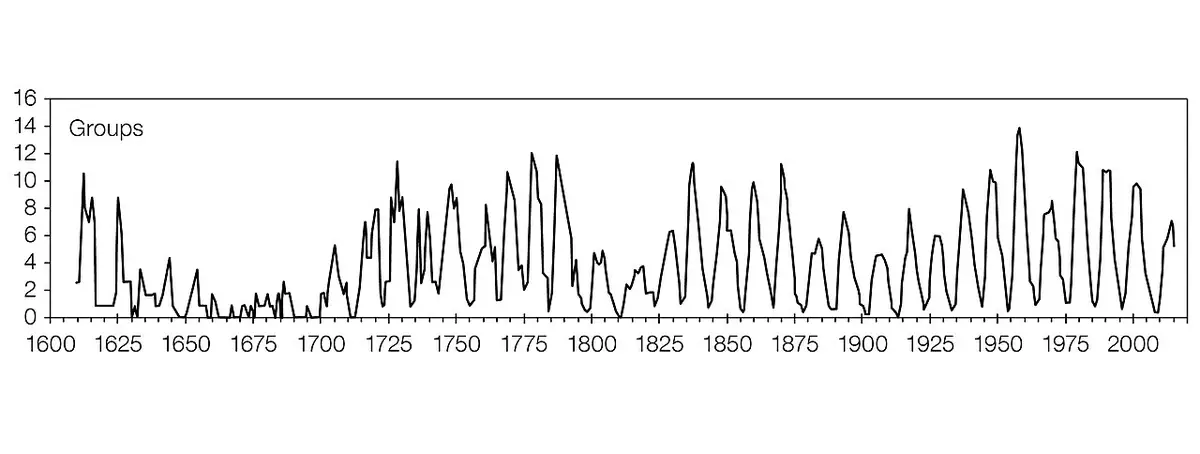
Between 1645 and 1715 (the Maunder Minimum), sunspots almost vanished and Europe experienced cold winters during the Little Ice Age. In 2015, a study by Valentina Zharkova and colleagues predicted a similar drop in sunspots during Cycles 26–27 (the 2030s). Online headlines quickly claimed a 'mini ice age' was coming. Climate physicists have tested how much a Maunder-style quiet Sun actually changes global temperatures.
The recalibrated sunspot group number since 1610 (WDC-SILSO). The flat stretch around 1645–1715 is the Maunder Minimum. Image: WDC-SILSO, CC BY 4.0, via Wikimedia Commons. Resized.
✓ Evidence and arguments for
The 2-wave magnetic forecast. Zharkova et al. (2015) modeled two magnetic waves inside the Sun and predicted they will cancel each other out during Cycles 26–27 (roughly 2030–2040), producing a quiet Sun. [1]
The 1600s Maunder Minimum. Historical records link the 1645–1715 sunspot drought to colder European winters during the Little Ice Age (alongside major volcanic eruptions). [2]
Regional winter cooling in Europe & the US. Ineson et al. (2015) found that a sharp drop in solar ultraviolet light can shift jet-stream winds, bringing colder winter spells to northern Europe and eastern North America. [3]
🔬 Evidence and arguments against
Only 0.1 to 0.3 °C of global cooling. Feulner & Rahmstorf (2010) calculated that a new Maunder Minimum would cool the planet by at most 0.3 °C—much smaller than human-driven greenhouse warming. [2]
Roughly a 2-year pause in warming. Ineson et al. (2015) found that a future grand solar minimum would cool the global average by only 0.12–0.13 °C, equal to about two years of current warming trends. [3]
The 2019 'solar cooling' paper was retracted. A follow-up 2019 paper by Zharkova et al. that claimed Sun-Earth distance changes would cause deep cooling was retracted by Scientific Reports in March 2020 because of orbital physics errors. [4][5]
Cycle 25 rose instead of falling. Solar Cycle 25 (160.9) grew stronger than Cycle 24 (116.4), showing the Sun is not sliding steadily downward right now. [6]
Historical perspective: In a 2026 history essay, Berrilli and Penza write that the Sun's total light has changed only a little since the Maunder Minimum. They say these small changes show no clear link to the fast rise in Earth's heat in recent years. This is how the authors sum up other studies. It is not new data, and we could not confirm that the essay was peer reviewed. [7]
Open questions & what would change the label
Will Solar Cycles 26 and 27 actually drop into a quiet spell in the 2030s? We will know within 10 to 15 years as the Sun's polar fields build up for the next cycle.
Primary Scientific Sources (7)
Zharkova, V. V. et al. (2015). Heartbeat of the Sun from Principal Component Analysis and prediction of solar activity on a millennium timescale. Scientific Reports. doi:10.1038/srep15689proponent
Feulner, G. & Rahmstorf, S. (2010). On the effect of a new grand minimum of solar activity on the future climate on Earth. Geophysical Research Letters. doi:10.1029/2010GL042710critic/test
Ineson, S. et al. (2015). Regional climate impacts of a possible future grand solar minimum. Nature Communications. doi:10.1038/ncomms8535test
Zharkova, V. V. et al. (2019). [RETRACTED] Oscillations of the baseline of solar magnetic field and solar irradiance on a millennial timescale. Scientific Reports. doi:10.1038/s41598-019-45584-3retracted
Retraction Note (2020): Oscillations of the baseline of solar magnetic field and solar irradiance on a millennial timescale. Scientific Reports. doi:10.1038/s41598-020-61020-3retraction
Berrilli, F. & Penza, V. (2026). From Galileo's Observations to Baliani's Hypothesis: An Early Seventeenth-Century Debate on Solar Variability. Solar Physics 301: 165 (Perspective article; peer review not confirmed). doi:10.1007/s11207-026-02758-3historical perspective
Joanna D. Haigh & Peter Cargill · ISBN 9780691153841
Two physicists explain how much the Sun's brightness and ultraviolet rays actually change over the 11-year sunspot cycle. They also test how much quiet-Sun periods (like the 1600s Maunder Minimum) cool Earth's climate.
Why this book matters to both sides
Directly addresses the 'Grand Solar Minimum / Mini Ice Age' debate using satellite measurements of solar output and upper-air winds.
Nearest Star: The Surprising Science of Our Sun (2nd ed.)
Leon Golub & Jay M. Pasachoff · ISBN 9781107672642
A clear, readable tour of how the Sun works from the inside out. Two veteran solar astronomers explain core nuclear fusion, the 11-year sunspot cycle, solar flares, and billion-ton coronal mass ejections.
Why this book matters to both sides
Gives the standard physics baseline for how the Sun generates heat and magnetic storms. That you can compare against alternative Electric Sun and superflare ideas.
Forgotten Civilization: New Discoveries on the Solar-Induced Dark Age (Revised ed.)
Robert M. Schoch with Catherine Ulissey · ISBN 9781644112922
Boston University geologist Robert Schoch presents his water-weathering case for an older Great Sphinx alongside his Leading Edge hypothesis that giant solar outbursts around 9700 BCE melted the Ice Age glaciers.
Why this book matters to both sides
The primary Leading Edge book arguing that an extreme solar superstorm—rather than a comet impact—ended the last Ice Age and left plasma patterns in ancient rock art.
Earth Under Fire: Humanity's Survival of the Ice Age
Paul A. LaViolette · ISBN 9781591430520
Sets out the Leading Edge 'galactic superwave' hypothesis. LaViolette argues that cosmic-ray blasts from the center of our galaxy periodically push cosmic dust into the solar system, triggering giant solar flares and Ice Age floods.
Why this book matters to both sides
Presents the cosmic-ray and solar-dust catastrophe model often cited alongside solar micronova claims. That readers can compare against polar ice-core beryllium-10 records.
FTC affiliate disclosure: Book links above go to Bookshop.org (Affiliate ID 130218, shop Search for the Truth), which supports independent bookstores. If you buy through one of these links, Solar Evidence earns a 10% commission at no extra cost to you. All affiliate links carry rel="sponsored nofollow noopener". Every recommended title is verified in print and meets our 4.3+/5 reader or landmark scholarly reputation standard; commissions never influence our evidence labels. Affiliate policy.
Interest signal: Wikipedia 'Maunder Minimum' averaged 3,189 views/month and 'Dalton Minimum' 742 (Oct 2025–Sep 2026). Sources were checked against Crossref/publisher pages on 2026-10-27. Labels describe the claim, not the people who hold it. Disclaimer.