Educational reference only—not for operational or safety decisions. For official alerts use NOAA SWPC.
Claims › The Sun & space weather › Electric comets (Electric Universe / Thunderblog claims)
Electric comets (Electric Universe / Thunderblog claims)
Status: Leading Edge / ContestedVerdict: Measured: Rosetta in-situ data at Comet 67P confirmed exposed water ice, sublimation outgassing, and low bulk density (~0.53 g/cm³)
The claim: Comets are dry, electrically charged rocks. Their jets and glowing tails come from electric sparks in the solar wind, not from ice melting in sunlight.
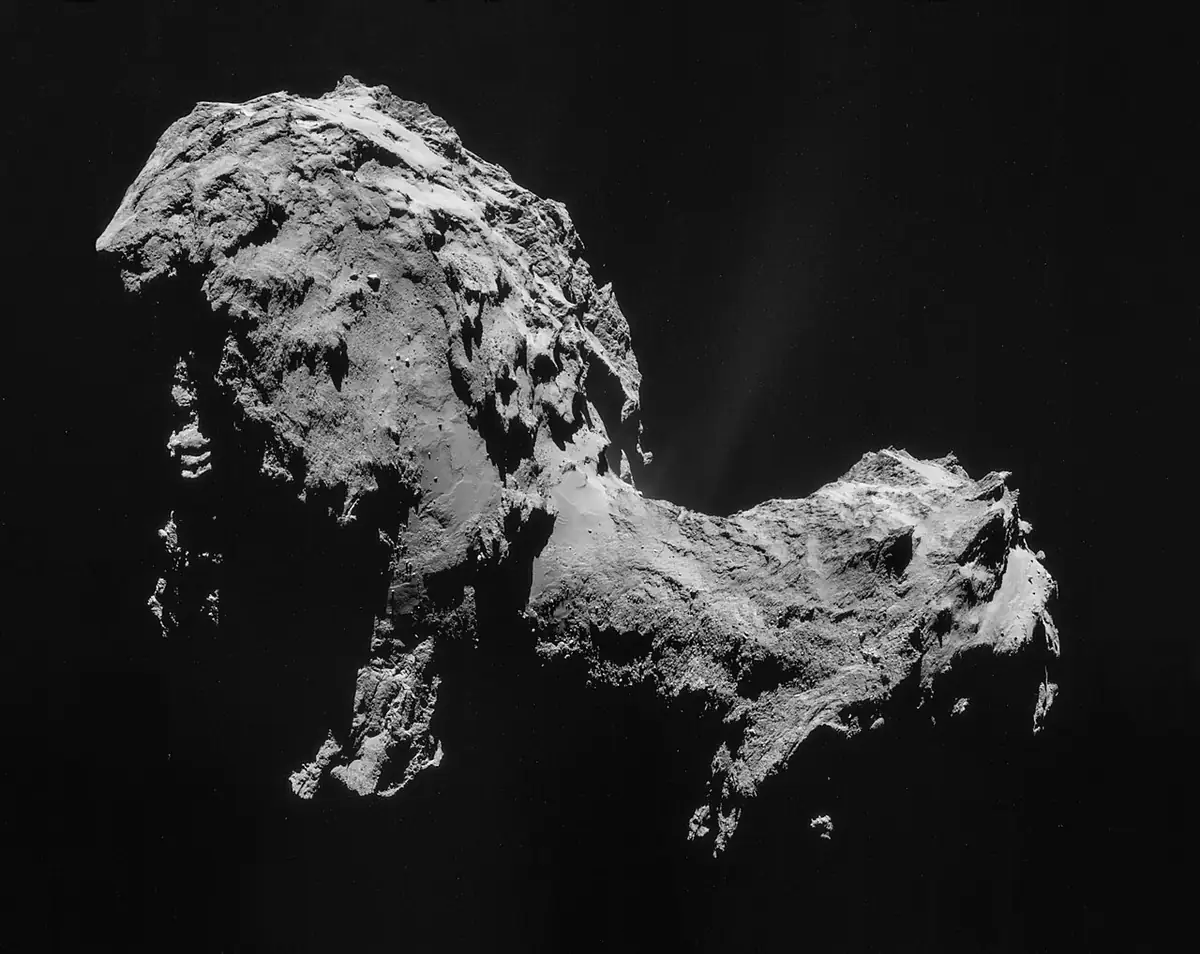
Why this label: Spacecraft have now landed on and orbited comets up close. At Comet 67P, the European Rosetta mission directly measured exposed water ice, escaping steam, and a light, fluffy density half that of water. That matches an icy dirtball, not a solid dry rock carved by lightning.
Background
The Thunderbolts Project argues that comets are dry, solid rocks carved by electric arcs as they fly through the Sun's electric field. The standard 'icy dirtball' model (proposed by Fred Whipple in 1950) says comets are porous mixes of ice and dust that vent steam when warmed by sunlight. ESA's Rosetta spacecraft orbited Comet 67P for two years (2014–2016) and tested both ideas directly. In October 2026, James Webb Space Telescope (JWST) near- and mid-infrared spectroscopy of interstellar comet 3I/ATLAS extended those tests to a comet from another star system.
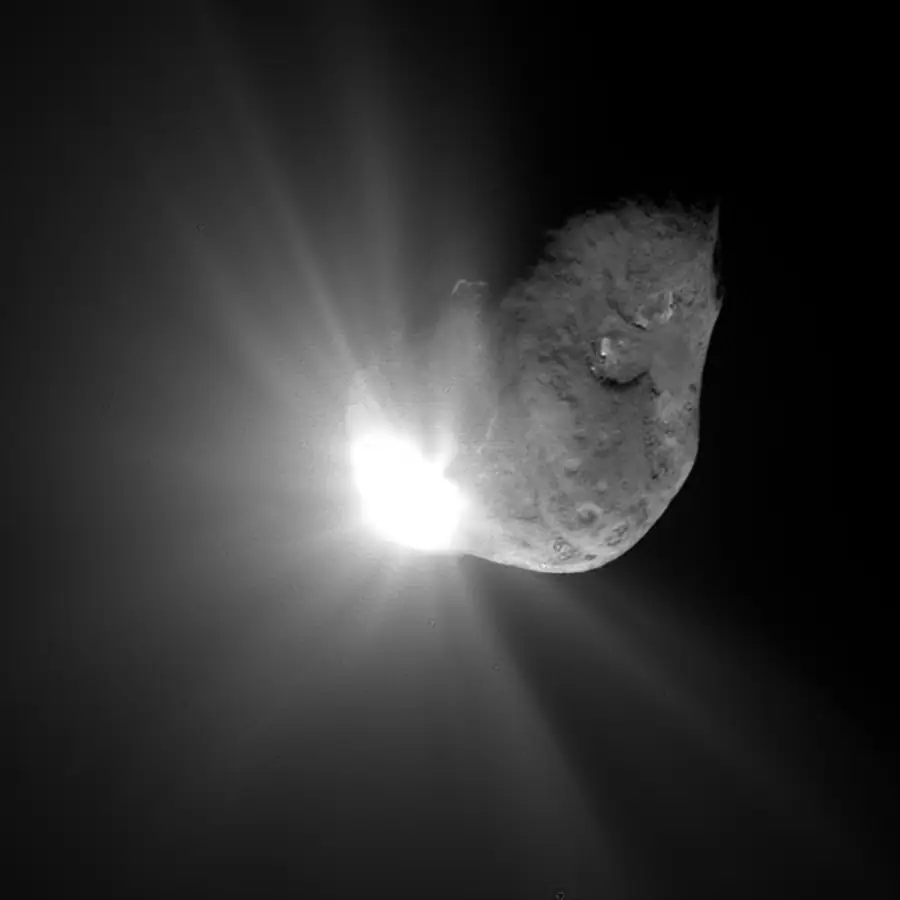
Comet Tempel 1 just after the Deep Impact collision on 4 July 2005 (NASA/JPL-Caltech/UMD). Image: NASA/JPL-Caltech/UMD, Public domain, via Wikimedia Commons. Resized.Comet 67P from ESA's Rosetta, with jets of gas and dust. Image: ESA/Rosetta/NAVCAM, CC BY-SA 3.0 igo, via Wikimedia Commons. Resized.
✓ Evidence and arguments for
Sharp cliffs and craters on comets. Electric-comet proponents argue that steep cliffs, flat craters, and X-ray glows on comets look more like electrical machining than gentle ice melting. [1]
High-temperature minerals in comet dust. Spacecraft found minerals in comet dust that form at high heat, showing that early solar-system history mixed hot inner-system dust with outer-system ice. [2][8]
Real plasma waves around Comet 67P. Rosetta's instruments did measure electric-field waves in the gas cloud around Comet 67P, confirming that normal solar-wind plasma effects occur around comets. [3]
🔬 Evidence and arguments against
Exposed water ice on the surface. Rosetta's infrared camera directly mapped patches of exposed water ice on the surface of Comet 67P. [4]
Tons of water vapor venting into space. Rosetta's mass spectrometer sniffed the gas pouring off Comet 67P and confirmed it was water steam, measuring its exact heavy-water (D/H) ratio. [5]
Lighter than water (72% porous). Radio-gravity tracking showed Comet 67P has a density of just 533 kg/m³—about half the density of water—meaning its interior is a fluffy mix of ice and dust, not solid rock. [6]
Deep Impact confirmed a fluffy nucleus. When NASA's Deep Impact probe hit Comet Tempel 1 in 2005, the ejecta cloud showed fine, weak dust and ice with a density around 600 kg/m³. [7]
2026 JWST spectra of interstellar comet 3I/ATLAS. Even a comet from another star system shows water ice and sublimating gases. In two October 2026 JWST preprints, NIRSpec spectra across 2.38–5.65 AU (Protopapa, Cordiner et al., arXiv:2609.19286) measured H₂O, CO₂, and CO gas outgassing plus a strong 3 µm water-ice band (with suppressed 1.5 and 2.0 µm bands), and MIRI LRS spectra at 2.21 AU (Thomas et al., arXiv:2610.37540) measured a smooth 10 µm amorphous silicate feature (≤5.3% crystalline upper limit). Modeled submicron-to-micron dust-and-ice grain mixes and silicate-to-carbon ratios remain model-dependent. [10][11]
2026 JWST: heavy methane in 3I/ATLAS. A third JWST study (Roth et al., Nature Astronomy, Oct 23, 2026) measured methane gas around 3I/ATLAS. Its methane has a deuterium-to-hydrogen (D/H) ratio of 3.18% ± 0.30%. That is 13 ± 2 times the level Rosetta measured at Comet 67P, and higher than any methane measured in the Solar System. The authors' reading: they say this fits ices that formed in a cold, metal-poor place under strong cosmic rays. They call it consistent with the data, not proven. Open question: the result comes from one object, seen during one observing period. No methane D/H has yet been measured around another star to compare it with. [12]
Open questions & what would change the label
How sunlit ice jets move boulders and carve sinkholes on Comet 67P remains an active topic in planetary geology. What would change the status: a quantitative electrical model that accounts for the low density and measured water-ice output of comets.
Karlsson, T. et al. (2017). Rosetta measurements of lower hybrid frequency range electric field oscillations in the plasma environment of comet 67P. Geophysical Research Letters. doi:10.1002/2016GL072419background
Filacchione, G. et al. (2016). Exposed water ice on the nucleus of comet 67P/Churyumov–Gerasimenko. Nature. doi:10.1038/nature16190critic/test
Altwegg, K. et al. (2015). 67P/Churyumov-Gerasimenko, a Jupiter family comet with a high D/H ratio. Science. doi:10.1126/science.1261952critic/test
Pätzold, M. et al. (2016). A homogeneous nucleus for comet 67P/Churyumov–Gerasimenko from its gravity field. Nature. doi:10.1038/nature16535critic/test
A'Hearn, M. F. et al. (2005). Deep Impact: Excavating Comet Tempel 1. Science. doi:10.1126/science.1118923critic/test
Whipple, F. L. (1950). A comet model. I. The acceleration of Comet Encke. Astrophysical Journal. doi:10.1086/145272background
Protopapa, S., Kelley, M. S. P., Cordiner, M. A. et al. (2026). JWST Reveals Refractory-Rich Water Ice in Interstellar Comet 3I/ATLAS: Evidence for a Continuum of Grain Properties across Protoplanetary Disks. arXiv preprint arXiv:2609.19286. https://arxiv.org/abs/2609.19286preprint
Thomas, C. A., Kelley, M. S. P., Harker, D. E., Cordiner, M. A. et al. (2026). JWST/MIRI Observations of Amorphous Silicates in Interstellar Comet 3I/ATLAS. arXiv preprint arXiv:2610.37540. https://arxiv.org/abs/2610.37540preprint
Roth, N. X., Cordiner, M., Milam, S. N., Villanueva, G. L., Charnley, S. B., Biver, N. et al. (2026). An enriched methane D/H ratio in the interstellar object 3I/ATLAS. Nature Astronomy (published 23 October 2026). doi:10.1038/s41550-026-03002-5critic/test
How to Kill an Asteroid: The Real Science of Planetary Defense
Robin George Andrews · ISBN 9781324131366
Science journalist Robin George Andrews goes inside NASA's DART mission. That intentionally crashed a spacecraft into an asteroid to change its orbit. Explains how astronomers hunt 'city-killer' space rocks and defend Earth.
Why this book matters to both sides
Explains how planetary radar tracks near-Earth asteroids and rules out impacts—essential reading for the 19,656-mile close pass of asteroid Apophis on Friday, April 13, 2029.
Geologist Walter Alvarez tells the true detective story of how a thin layer of cosmic iridium clay and the buried Chicxulub crater in Mexico proved that a giant asteroid wiped out the dinosaurs 66 million years ago.
Why this book matters to both sides
Shows both sides of how science tests a catastrophe claim: why geologists doubted cosmic impacts for decades. What hard physical proof finally changed their minds.
Leaving out ancient folklore, Velikovsky's 1955 book gathered real geological puzzles—frozen Alaskan mammoth beds, polar coal seams, and reversed-polarity lava rocks (Ch. IX)—to argue against slow-and-steady geology.
Why this book matters to both sides
A 1955 book that proposed sudden pole shifts. It cited reversed lavas, which later work showed are magnetic flips in the core. Its crust-slip timeline was not supported.
The Cycle of Cosmic Catastrophes: How a Stone-Age Comet Changed the Course of World Culture
Richard Firestone, Allen West & Simon Warwick-Smith · ISBN 9781591430612
Written by members of the team that proposed the Younger Dryas comet impact. They argue that fragments of a giant comet exploded over North America 12,800 years ago, wiping out mammoths and triggering a 1,200-year cold snap.
Why this book matters to both sides
Gives the founding proponents' case for the 12,800-year-ago comet impact hypothesis, contrasting directly with both solar-outburst ideas and mainstream ocean-current models.
FTC affiliate disclosure: Book links above go to Bookshop.org (Affiliate ID 130218, shop Search for the Truth), which supports independent bookstores. If you buy through one of these links, Solar Evidence earns a 10% commission at no extra cost to you. All affiliate links carry rel="sponsored nofollow noopener". Every recommended title is verified in print and meets our 4.3+/5 reader or landmark scholarly reputation standard; commissions never influence our evidence labels. Affiliate policy.
Interest signal: Electric Universe content draws a steady online audience; see the shortlist research for pageview data on related topics. Sources were checked against Crossref/publisher pages on 2026-10-29. Labels describe the claim, not the people who hold it. Disclaimer.