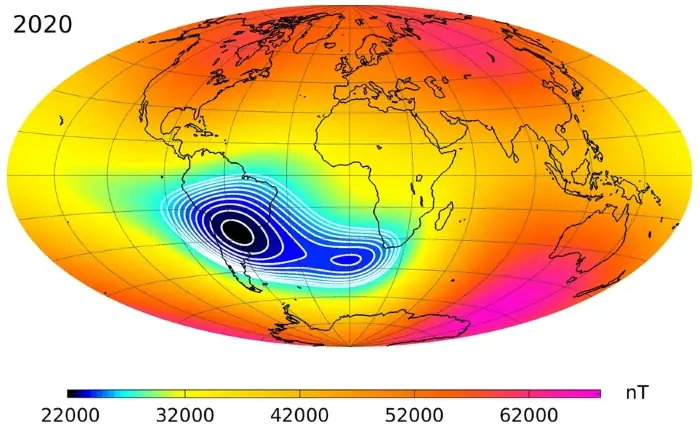
The South Atlantic Anomaly is growing and splitting
Status: MainstreamVerdict: Supported by satellite data
The claim: The weak spot in Earth's magnetic field over the South Atlantic is expanding, deepening and dividing into two lobes.
Why this label: European Swarm satellites confirm both parts of this claim: between 2014 and 2025, the weak-field zone over the South Atlantic expanded by an area nearly half the size of Europe, and a second weak center has started splitting off southwest of Africa.
Background
The South Atlantic Anomaly (SAA) is a large region stretching from South America to southern Africa where Earth's magnetic shield is weaker than normal. Because the shield dips closer to Earth there, orbiting satellites and the International Space Station get hit by extra radiation particles when they fly through it. At ground level, however, Earth's thick blanket of air absorbs those particles completely, so the anomaly poses zero danger to people on the surface.
The South Atlantic Anomaly in 2020, from the CHAOS-7 field model (Finlay et al.). Image: Christopher C. Finlay, Clemens Kloss, Nils Olsen, Magnus D. Hammer, Lars Tøffner-Clausen, Alexander Grayver & Alexey Kuvshinov, CC BY-SA 4.0, via Wikimedia Commons. Resized.
✓ Evidence and arguments for
Grew by half the size of Europe (2014–2025). Eleven years of ESA Swarm satellite data show the area below 26,000 nT grew by 0.9% of Earth's surface, while its weakest point dropped from 22,430 nT to 22,094 nT. [1]
New weak lobe forming near Africa. Since 2020, a second pocket southwest of Africa has weakened rapidly, driven by patches of reversed magnetic flux at the top of the liquid iron core beneath Africa. [2]
Drifting westward & splitting in two. Between 1970 and 2020, the weak spot drifted west at about 12 miles (20 km) per year and began dividing into two distinct cells. [3]
Confirmed in NOAA's 2025 report. NOAA's 2025 State of the Geomagnetic Field report confirmed the anomaly continued expanding and deepening over the past year. [4]
🔬 Evidence and arguments against
No hazard at ground level. ESA and NASA emphasize that Earth's atmosphere blocks the radiation at the surface. The weak spot only affects spacecraft in orbit. [3]
Similar weak spots healed 46,000 years ago. Paleomagnetic studies (Brown et al. 2018) show that similar South Atlantic weak spots formed 49,000 and 46,000 years ago and recovered naturally without flipping Earth's poles. [5]
Open questions & what would change the label
How long will the reversed-flux patch under southern Africa keep growing? Satellites monitor the region continuously to protect spacecraft electronics.
Primary Scientific Sources (5)
Finlay, C. C. et al. (2025). Core field changes from eleven years of Swarm satellite observations. Physics of the Earth and Planetary Interiors. doi:10.1016/j.pepi.2025.107447data
The Spinning Magnet: The Electromagnetic Force That Created the Modern World—and Could Destroy It
Alanna Mitchell · ISBN 9781101985182
Science journalist Alanna Mitchell visits the geophysicists studying Earth's molten iron core, the growing weak spot over the South Atlantic. The temporary magnetic flip 41,000 years ago. Explores what a future flip would do to satellites and power grids.
Why this book matters to both sides
Bridges both sides of the magnetic pole-shift debate by combining mainstream satellite data with an honest look at how a weak magnetic shield exposes modern technology to solar storms.
Award-winning geophysicist Ronald Merrill explains how churning liquid iron 1,800 miles underfoot creates Earth's magnetic shield. He also explains why magnetic pole flips are completely different from the solid planet tipping over.
Why this book matters to both sides
Crucial for separating the three ideas often mixed up under 'pole shift': magnetic flips in the liquid core, slow tipping of the whole planet over millions of years, and rapid crust-slip claims.
Forgotten Civilization: New Discoveries on the Solar-Induced Dark Age (Revised ed.)
Robert M. Schoch with Catherine Ulissey · ISBN 9781644112922
Boston University geologist Robert Schoch presents his water-weathering case for an older Great Sphinx alongside his Leading Edge hypothesis that giant solar outbursts around 9700 BCE melted the Ice Age glaciers.
Why this book matters to both sides
The primary Leading Edge book arguing that an extreme solar superstorm—rather than a comet impact—ended the last Ice Age and left plasma patterns in ancient rock art.
Earth Under Fire: Humanity's Survival of the Ice Age
Paul A. LaViolette · ISBN 9781591430520
Sets out the Leading Edge 'galactic superwave' hypothesis. LaViolette argues that cosmic-ray blasts from the center of our galaxy periodically push cosmic dust into the solar system, triggering giant solar flares and Ice Age floods.
Why this book matters to both sides
Presents the cosmic-ray and solar-dust catastrophe model often cited alongside solar micronova claims. That readers can compare against polar ice-core beryllium-10 records.
FTC affiliate disclosure: Book links above go to Bookshop.org (Affiliate ID 130218, shop Search for the Truth), which supports independent bookstores. If you buy through one of these links, Solar Evidence earns a 10% commission at no extra cost to you. All affiliate links carry rel="sponsored nofollow noopener". Every recommended title is verified in print and meets our 4.3+/5 reader or landmark scholarly reputation standard; commissions never influence our evidence labels. Affiliate policy.
Interest signal: Wikipedia 'South Atlantic Anomaly' averaged 5,911 views/month (Oct 2025-Sep 2026). Sources were checked against Crossref/publisher pages on 2026-10-22. Labels describe the claim, not the people who hold it. Disclaimer.