Status: Leading Edge / ContestedVerdict: Open question
The claim: Activity on the Sun (flares, CMEs, a 'micronova' or similar outbursts) triggers geomagnetic reversals or physical pole shifts.
Where the evidence stands: Mainstream geophysics shows that magnetic reversals come from churning liquid iron deep inside Earth's core, which flips on its own without outside triggers. While solar storms rattle compass needles for a day or two, no evidence shows that solar flares flip the deep core dynamo or tilt the solid planet. Graded Leading Edge — Open question.
Big solar storms (coronal mass ejections) slam into Earth's outer magnetic shield and shake it for 24 to 48 hours, lighting up the aurora and making compass needles wiggle at high latitudes. However, the claim here is much bigger: that a giant solar outburst can permanently flip Earth's magnetic poles or cause the solid crust to slide. See also our solar micronova and rapid crustal displacement reviews.
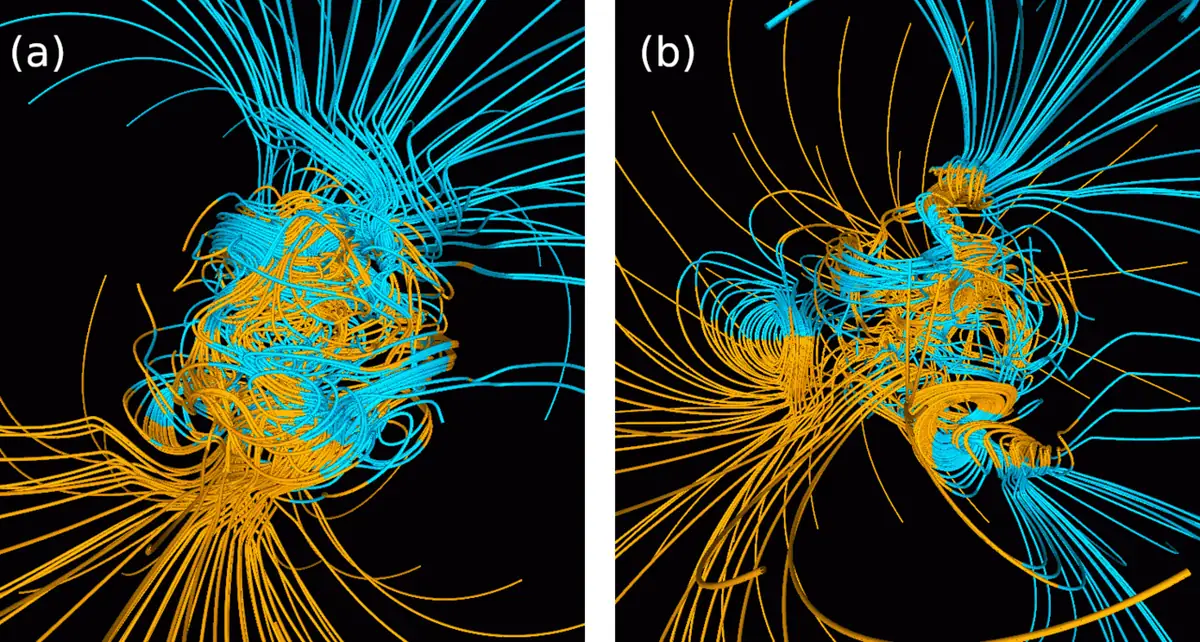
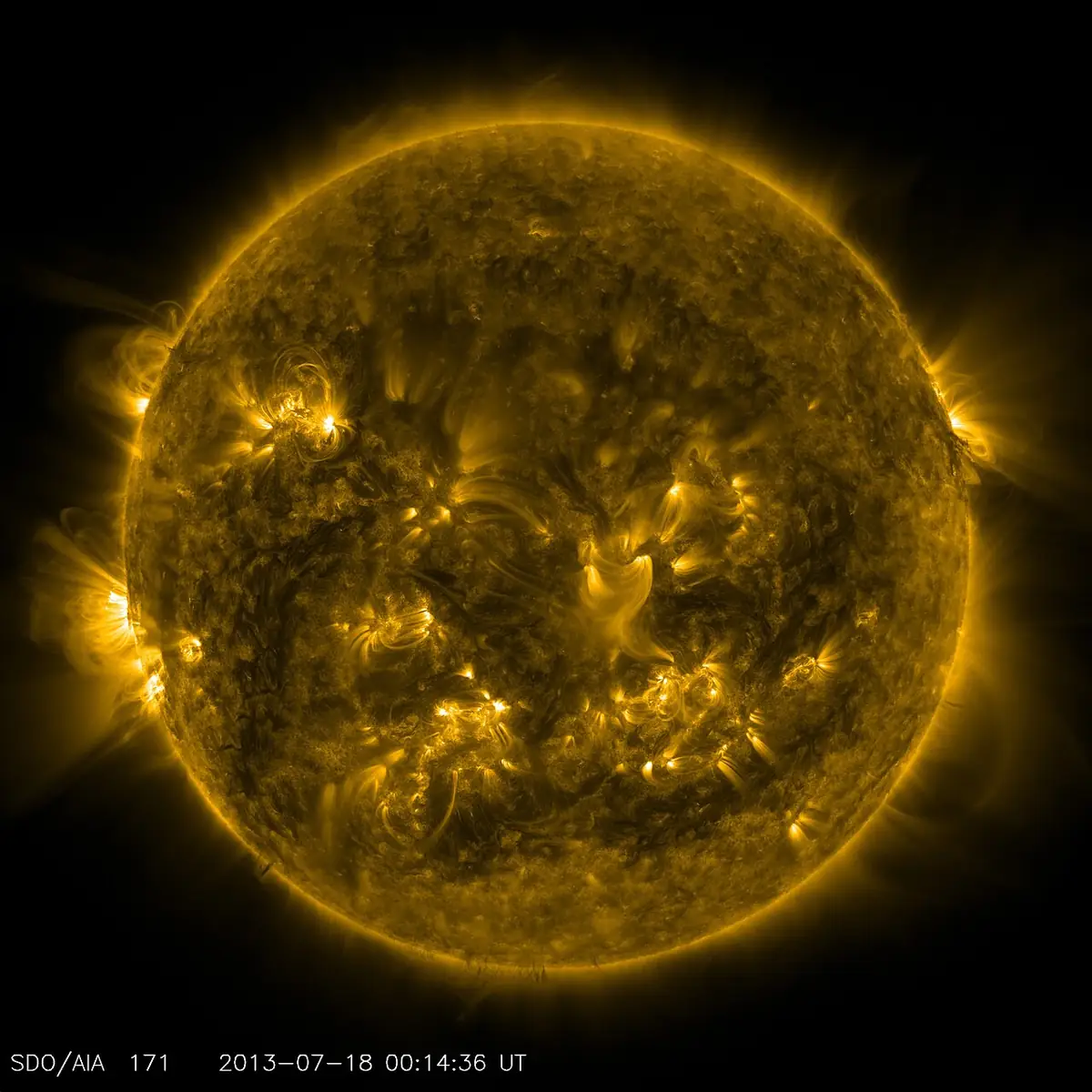
Glatzmaier–Roberts computer simulation of Earth's field before and during a reversal. Reversals start in the core. Image: Gary A. Glatzmaier (NASA-funded simulation); derivative work by MikeRun, Public domain, via Wikimedia Commons. Resized.The Sun at 171 Å (NASA/SDO). Image: NASA/SDO and the AIA, EVE and HMI science teams, Public domain, via Wikimedia Commons. Resized.
⚖ Proponents' main arguments and cited evidence
Solar micronova & crust-slip proposals. Proponents of the 12,000-year solar micronova hypothesis (and Rand & Rose Flem-Ath's Atlantis Beneath the Ice) propose that an extreme solar blast can electromagnetically torque the crust or trigger a magnetic flip. [1]
USGS notes outside triggers are 'extremely unlikely' but studied. In its FAQ on whether impacts or ice-sheet changes could trigger a magnetic reversal, the USGS calls external triggers 'extremely unlikely' while noting core-mantle boundary interactions have been discussed theoretically. [2]
Solar storms cause temporary compass shifts. NOAA reports 18 strong-to-severe geomagnetic storms between late 2023 and late 2025, which temporarily shifted local magnetic declination at high latitudes for hours. [3]
🔬 The mainstream scientific position and its evidence
The core dynamo flips on its own. Computer simulations and USGS geophysicists show that Earth's liquid iron outer core naturally reverses polarity from its own internal fluid turbulence, needing no outside push. [2]
Storm disturbances bounce right back. Once a 1-to-3-day solar storm passes, Earth's main core field returns to its steady path, which sits 1,800 miles beneath the electrically conductive mantle. [3][4]
Even Chan Thomas dropped sunspots as the trigger. Chan Thomas, author of the 1963 pole-shift book The Adam and Eve Story, wrote that he once suspected sunspots triggered pole shifts 'but we were wrong'. [5]
What evidence would help settle it
What would settle it: a dated geological record showing that magnetic excursions or reversals consistently start at the exact same year as extreme solar radiation spikes (Miyake events).
Award-winning geophysicist Ronald Merrill explains how churning liquid iron 1,800 miles underfoot creates Earth's magnetic shield. He also explains why magnetic pole flips are completely different from the solid planet tipping over.
Why this book matters to both sides
Crucial for separating the three ideas often mixed up under 'pole shift': magnetic flips in the liquid core, slow tipping of the whole planet over millions of years, and rapid crust-slip claims.
The Spinning Magnet: The Electromagnetic Force That Created the Modern World—and Could Destroy It
Alanna Mitchell · ISBN 9781101985182
Science journalist Alanna Mitchell visits the geophysicists studying Earth's molten iron core, the growing weak spot over the South Atlantic. The temporary magnetic flip 41,000 years ago. Explores what a future flip would do to satellites and power grids.
Why this book matters to both sides
Bridges both sides of the magnetic pole-shift debate by combining mainstream satellite data with an honest look at how a weak magnetic shield exposes modern technology to solar storms.
Forgotten Civilization: New Discoveries on the Solar-Induced Dark Age (Revised ed.)
Robert M. Schoch with Catherine Ulissey · ISBN 9781644112922
Boston University geologist Robert Schoch presents his water-weathering case for an older Great Sphinx alongside his Leading Edge hypothesis that giant solar outbursts around 9700 BCE melted the Ice Age glaciers.
Why this book matters to both sides
The primary Leading Edge book arguing that an extreme solar superstorm—rather than a comet impact—ended the last Ice Age and left plasma patterns in ancient rock art.
Atlantis Beneath the Ice: The Fate of the Lost Continent
Rand Flem-Ath & Rose Flem-Ath (Afterword by John Anthony West) · ISBN 9781591431374
Builds on Charles Hapgood's shifting-crust idea and ancient maps like the 1513 Piri Reis chart. The authors argue that a crust slip around 9600 BCE pushed Antarctica into the polar zone and ask whether solar storms could help trigger a slip.
Why this book matters to both sides
Shows how modern Leading Edge writers connect Hapgood's crust-slip hypothesis to solar activity and Ice Age flood traditions.
FTC affiliate disclosure: Book links above go to Bookshop.org (Affiliate ID 130218, shop Search for the Truth), which supports independent bookstores. If you buy through one of these links, Solar Evidence earns a 10% commission at no extra cost to you. All affiliate links carry rel="sponsored nofollow noopener". Every recommended title is verified in print and meets our 4.3+/5 reader or landmark scholarly reputation standard; commissions never influence our evidence labels. Affiliate policy.
Interest signal: Wikipedia 'Geomagnetic storm' averaged 9,940 views/month (Oct 2025-Sep 2026). Sources were checked against Crossref/publisher pages on 2026-10-22. This entry presents a debated idea neutrally: proponents' case first, then the mainstream position, in our own words. It is not a prediction and not safety advice. Labels describe the claim, not the people who hold it. Disclaimer.