Status: MainstreamVerdict: Supported, but it has slowed
The claim: The north magnetic pole is moving quickly from the Canadian Arctic toward Siberia.
Why this label: The direction is 100% confirmed: the North Magnetic Pole has crossed the Arctic from Canada toward Siberia. However, the 'racing' speed has slowed down. Dropping from a record 34 miles (55 km) per year in the 2000s to about 22 miles (35–36 km) per year in 2024–2026.
Background
The 'North Magnetic Pole' is the spot in the Arctic where a compass needle points straight down into the ground. It moves because rivers of molten iron shift inside Earth's outer core. British explorer James Clark Ross first found it in northern Canada in 1831. Every five years, NOAA and the British Geological Survey release an updated World Magnetic Model (most recently WMM2025 in December 2024) so airplanes, ships, and smartphones point in the right direction. Moving the magnetic pole does not move Earth's physical spin axis or the geographic North Pole.
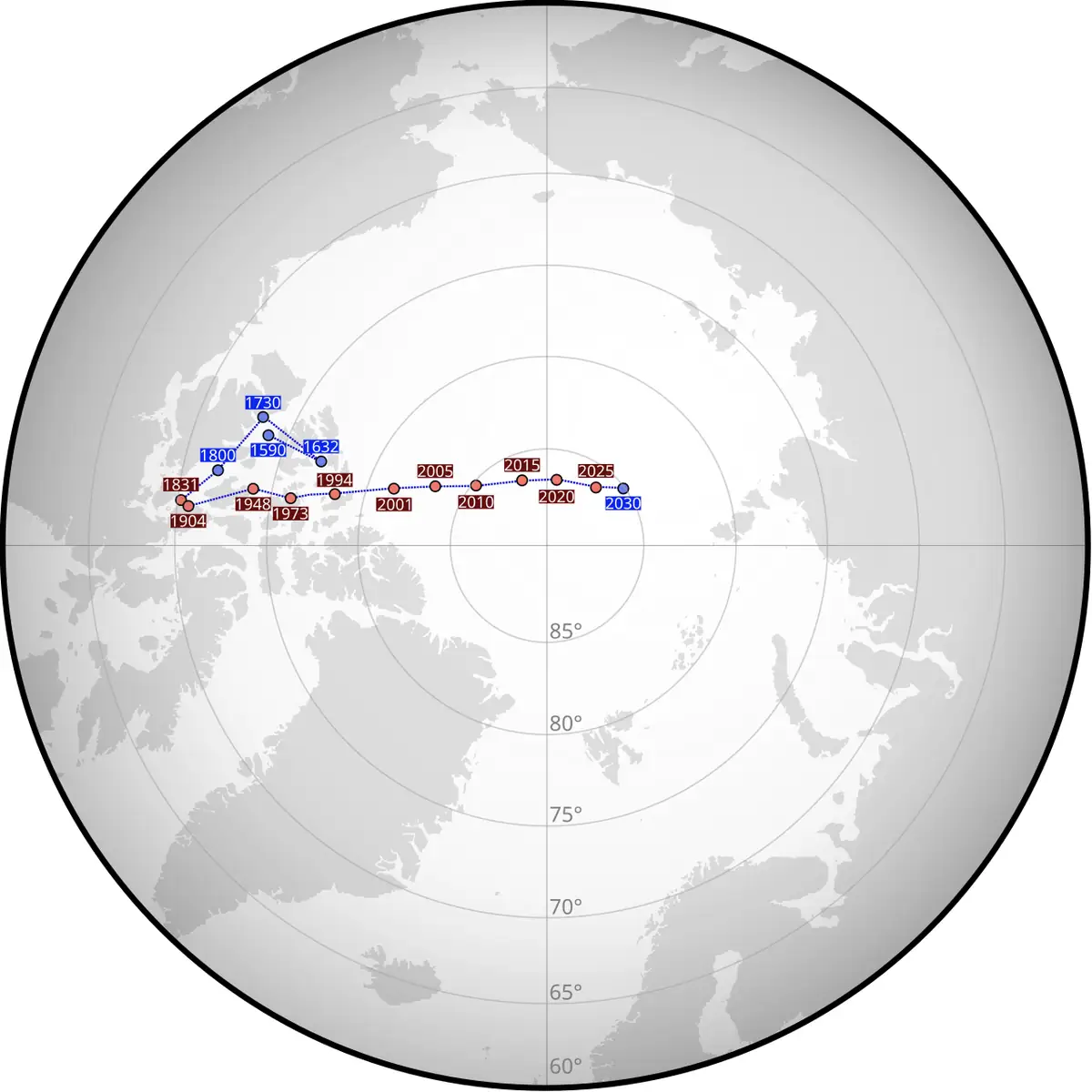
The north magnetic pole's track, from northern Canada towards Siberia. Image: Ecrusized, Public domain, via Wikimedia Commons. Resized.
✓ Evidence and arguments for
Crossed the Arctic from Canada toward Russia. In the WMM2025 model (for 2025.0), the North Magnetic Pole sits at 85.76°N, 139.30°E in the central Arctic Ocean. Hundreds of miles from its 1831 home in northern Canada. [1]
Five-fold speedup after 1990. The British Geological Survey reports that the pole crept along at ~6 miles (10 km) per year from 1600 to 1990, then sped up to 34 miles (55 km) per year in the 2000s. [2]
Continuing toward Siberia at 22 mph/yr. NOAA's 2025 annual geomagnetic report measured the north pole moving toward Siberia at 22 miles (36 km) per year, while the south magnetic pole crawls at just 5.5 miles (9 km) per year. [3]
🔬 Evidence and arguments against
Biggest slowdown ever recorded. Since 2019, the pole's sprint has braked sharply from 31–34 miles (50–55 km) per year down to 22 miles (35 km) per year. Which BGS geophysicist William Brown called 'the biggest deceleration in speed we've ever seen'. [4]
Forecast to keep slowing through 2030. The 2025–2030 World Magnetic Model predicts the pole will continue slowing down as it nears Siberia. [2]
Open questions & what would change the label
Satellite models link the pole's path to a tug-of-war between two underground lobes of magnetic flux beneath Canada and Siberia. Swarm satellites are watching whether the Canadian lobe regains strength.
Finlay, C. C. et al. (2025). Core field changes from eleven years of Swarm satellite observations. Physics of the Earth and Planetary Interiors. doi:10.1016/j.pepi.2025.107447data
The Spinning Magnet: The Electromagnetic Force That Created the Modern World—and Could Destroy It
Alanna Mitchell · ISBN 9781101985182
Science journalist Alanna Mitchell visits the geophysicists studying Earth's molten iron core, the growing weak spot over the South Atlantic. The temporary magnetic flip 41,000 years ago. Explores what a future flip would do to satellites and power grids.
Why this book matters to both sides
Bridges both sides of the magnetic pole-shift debate by combining mainstream satellite data with an honest look at how a weak magnetic shield exposes modern technology to solar storms.
Award-winning geophysicist Ronald Merrill explains how churning liquid iron 1,800 miles underfoot creates Earth's magnetic shield. He also explains why magnetic pole flips are completely different from the solid planet tipping over.
Why this book matters to both sides
Crucial for separating the three ideas often mixed up under 'pole shift': magnetic flips in the liquid core, slow tipping of the whole planet over millions of years, and rapid crust-slip claims.
Earth's Shifting Crust: A Key to Some Basic Problems of Earth Science
Charles H. Hapgood (Foreword by Albert Einstein) · ISBN 9781015422193
Carrying a famous foreword by Albert Einstein, Charles Hapgood's 1958 book proposes that the heavy weight of off-center polar ice caps periodically pulls Earth's outer crust over the interior, shifting continents into new latitudes.
Why this book matters to both sides
The foundational book behind physical 'crustal displacement' pole-shift ideas, letting readers compare Hapgood's 1958 ice-weight argument with modern plate tectonics.
Atlantis Beneath the Ice: The Fate of the Lost Continent
Rand Flem-Ath & Rose Flem-Ath (Afterword by John Anthony West) · ISBN 9781591431374
Builds on Charles Hapgood's shifting-crust idea and ancient maps like the 1513 Piri Reis chart. The authors argue that a crust slip around 9600 BCE pushed Antarctica into the polar zone and ask whether solar storms could help trigger a slip.
Why this book matters to both sides
Shows how modern Leading Edge writers connect Hapgood's crust-slip hypothesis to solar activity and Ice Age flood traditions.
FTC affiliate disclosure: Book links above go to Bookshop.org (Affiliate ID 130218, shop Search for the Truth), which supports independent bookstores. If you buy through one of these links, Solar Evidence earns a 10% commission at no extra cost to you. All affiliate links carry rel="sponsored nofollow noopener". Every recommended title is verified in print and meets our 4.3+/5 reader or landmark scholarly reputation standard; commissions never influence our evidence labels. Affiliate policy.
Interest signal: Wikipedia 'North magnetic pole' averaged 9,909 views/month (Oct 2025-Sep 2026). Sources were checked against Crossref/publisher pages on 2026-10-22. Labels describe the claim, not the people who hold it. Disclaimer.