Educational reference only—not for operational or safety decisions. For official alerts use NOAA SWPC.
Claims › The Sun & space weather › The Electric Sun hypothesis
The Electric Sun hypothesis
Status: Leading Edge / ContestedVerdict: Measured: Borexino/SNO solar-neutrino fluxes and helioseismology match core nuclear fusion; coronal-heating currents remain an active research topic
The claim: The Sun is powered mainly by external electric currents flowing through space, not by nuclear fusion in its core.
Why this label: Deep underground detectors on Earth directly catch the tiny neutrino particles that nuclear fusion in the Sun's core creates. Sound waves inside the Sun also match a fusion-powered core. An externally powered Sun without core fusion predicts neither of these measured facts.
Background
The Electric Sun idea comes from the wider 'Electric Universe' movement, promoted online by the Thunderbolts Project. Proponents argue that electric currents in space plasma power the Sun and heat its outer atmosphere. Mainstream solar physicists agree that magnetic and electric forces drive flares in the Sun's atmosphere. However, they place the Sun's power plant in core nuclear fusion because detectors on Earth directly measure the neutrinos coming out of the core.
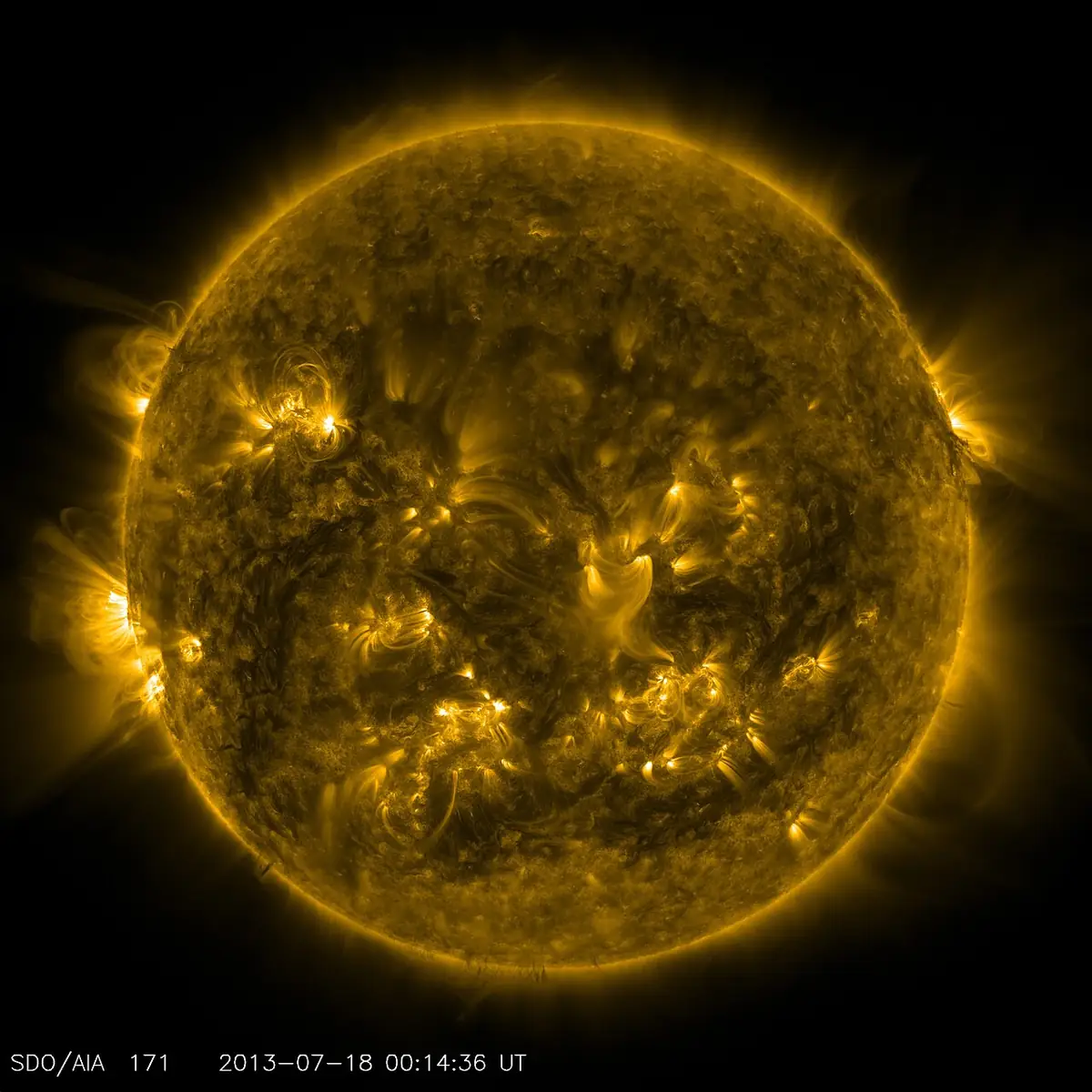
The solar corona at 171 Å from NASA's Solar Dynamics Observatory. The loops trace magnetic field lines in plasma at about a million kelvin. Image: NASA/SDO and the AIA, EVE and HMI science teams, Public domain, via Wikimedia Commons. Resized.
✓ Evidence and arguments for
Space is filled with plasma. Charged gas and electric currents run throughout space. Proponents argue astrophysics focuses too much on gravity and not enough on electricity, a view discussed in IEEE plasma journals. [1]
The hot-corona puzzle. The Sun's visible surface is about 5,800 K (10,000 °F), while its outer corona reaches millions of degrees. Proponents view this as a sign of outside electrical heating. Mainstream physicists explain it through magnetic waves and snapping field lines. [2]
Large public audience. The Thunderbolts Project publishes books, videos, and articles that keep electrical-cosmos ideas in public discussion. [3]
🔬 Evidence and arguments against
Direct proton-fusion neutrinos measured. The Borexino detector deep under an Italian mountain directly measured neutrinos from the main proton-proton fusion reaction in the Sun's core. The measured count matches the Sun's total light output. [4]
Second fusion cycle detected. In 2020, Borexino also measured neutrinos from the carbon-nitrogen-oxygen (CNO) fusion cycle inside the Sun's core, confirming a second independent fusion signature. [5]
The neutrino puzzle is solved. The Sudbury Neutrino Observatory (SNO) proved that neutrinos change 'flavor' on their way out of the Sun. Counting all three flavors matches standard core-fusion predictions. [6]
Solar sound waves match core fusion. Helioseismology tracks sound waves bouncing through the Sun's interior. The measured temperature and density profiles match a nuclear-fusion core to within a fraction of a percent. [7]
Open questions & what would change the label
How magnetic waves and snapping field lines heat the outer corona is still actively researched with Parker Solar Probe. What would change the status: a testable Electric Sun calculation that explains the measured core neutrino counts and internal sound-wave speeds.
Primary Scientific Sources (7)
Scott, D. E. (2007). Real Properties of Electromagnetic Fields and Plasma in the Cosmos. IEEE Transactions on Plasma Science. doi:10.1109/TPS.2007.895424proponent
Borexino Collaboration (2014). Neutrinos from the primary proton–proton fusion process in the Sun. Nature. doi:10.1038/nature13702critic/test
Borexino Collaboration (2020). Experimental evidence of neutrinos produced in the CNO fusion cycle in the Sun. Nature. doi:10.1038/s41586-020-2934-0critic/test
Ahmad, Q. R. et al., SNO Collaboration (2002). Direct Evidence for Neutrino Flavor Transformation from Neutral-Current Interactions in the Sudbury Neutrino Observatory. Physical Review Letters. doi:10.1103/PhysRevLett.89.011301critic/test
Nearest Star: The Surprising Science of Our Sun (2nd ed.)
Leon Golub & Jay M. Pasachoff · ISBN 9781107672642
A clear, readable tour of how the Sun works from the inside out. Two veteran solar astronomers explain core nuclear fusion, the 11-year sunspot cycle, solar flares, and billion-ton coronal mass ejections.
Why this book matters to both sides
Gives the standard physics baseline for how the Sun generates heat and magnetic storms. That you can compare against alternative Electric Sun and superflare ideas.
Mainstream Baseline2026★ New Oct 2026 · Harvard Univ. Press
The Turbulent Sun: A Natural History of Our Cosmic Origins and Future
Leon Golub · ISBN 9780674292444
Harvard–Smithsonian solar physicist Leon Golub explains how the solar wind carves out a giant magnetic bubble around our solar system. He shows how Earth's magnetic shield protects our air while unshielded planets lose theirs.
Why this book matters to both sides
Provides the latest spacecraft findings (from Parker Solar Probe and Voyager) on how magnetic fields shield planetary atmospheres over billions of years.
Leaving out ancient folklore, Velikovsky's 1955 book gathered real geological puzzles—frozen Alaskan mammoth beds, polar coal seams, and reversed-polarity lava rocks (Ch. IX)—to argue against slow-and-steady geology.
Why this book matters to both sides
A 1955 book that proposed sudden pole shifts. It cited reversed lavas, which later work showed are magnetic flips in the core. Its crust-slip timeline was not supported.
Forgotten Civilization: New Discoveries on the Solar-Induced Dark Age (Revised ed.)
Robert M. Schoch with Catherine Ulissey · ISBN 9781644112922
Boston University geologist Robert Schoch presents his water-weathering case for an older Great Sphinx alongside his Leading Edge hypothesis that giant solar outbursts around 9700 BCE melted the Ice Age glaciers.
Why this book matters to both sides
The primary Leading Edge book arguing that an extreme solar superstorm—rather than a comet impact—ended the last Ice Age and left plasma patterns in ancient rock art.
FTC affiliate disclosure: Book links above go to Bookshop.org (Affiliate ID 130218, shop Search for the Truth), which supports independent bookstores. If you buy through one of these links, Solar Evidence earns a 10% commission at no extra cost to you. All affiliate links carry rel="sponsored nofollow noopener". Every recommended title is verified in print and meets our 4.3+/5 reader or landmark scholarly reputation standard; commissions never influence our evidence labels. Affiliate policy.
Interest signal: Wikipedia 'Plasma cosmology' averaged 1,775 views/month (Oct 2025–Sep 2026). Sources were checked against Crossref/publisher pages on 2026-10-27. Labels describe the claim, not the people who hold it. Disclaimer.