Live Space Weather & Solar Dashboard
Real-time space weather, live spacecraft views of the Sun, and Earth's magnetic shield status—updated every build (Fri Nov 20, 16:09 UTC · 11:09 AM ET · 9:09 AM MT · 8:09 AM PT) and refreshed in your browser from NOAA SWPC, WDC Kyoto, and NASA SDO.
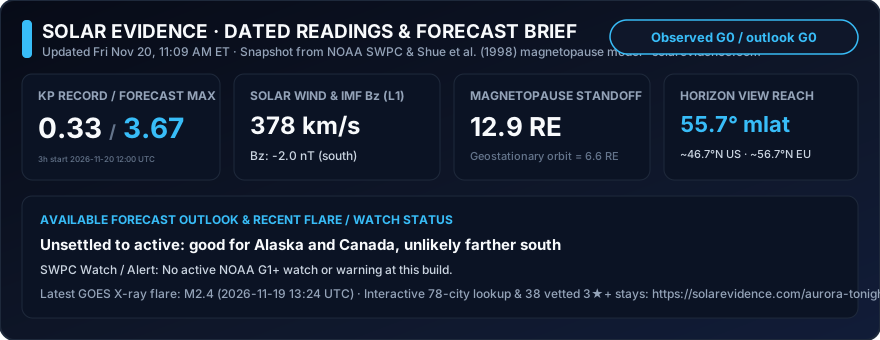
Space-weather readings and forecast outlook
Official NOAA G scale is G0. No active dated alert, warning, or watch is shown. G0 is below storm level; it is not a claim that Kp is at traditional quiet levels.
Latest official 3-hour Kp record: Kp 0.33 (observed), UTC block start Fri Nov 20, 12:00 UTC · 7:00 AM ET · 5:00 AM MT · 4:00 AM PT, block-start age 249.5 minutes. Not instantaneous, not the minute estimate, and not NOAA's official storm scale. NOAA's estimated Kp for the current 3-hour block is 2.67 (an estimate, not an official record).
Latest available minute Kp estimate: 0.33, source Nov 20, 16:04 UTC · 11:04 AM ET · 9:04 AM MT · 8:04 AM PT, age 5.5 minutes at build (provisional; not the 3-hour record). Retrieval/build time Fri Nov 20, 16:09 UTC · 11:09 AM ET · 9:09 AM MT · 8:09 AM PT is separate from source measurement time.
Latest available official scale sample: G0/S0/R0, source Nov 20, 16:08 UTC · 11:08 AM ET · 9:08 AM MT · 8:08 AM PT, age 1.5 minutes at build. Retrieval/build time Fri Nov 20, 16:09 UTC · 11:09 AM ET · 9:09 AM MT · 8:09 AM PT is separate; a younger dated sample is not certification of current conditions.
Available forecast (up to 48h): unsettled to active — good for Alaska and Canada, unlikely farther south
Peak of available forecast blocks (up to 48h): Kp 3.7 (Kp 5+ is a storm). Good for high latitudes (Alaska, Canada, Iceland, Norway, Lapland) on clear nights.
Normal Solar Breeze (~846,000 mph)
Earth's magnetic shield is holding steady at 12.9 Earth radii (~51,123 miles) up on the sunlit side. Solar-wind magnetic direction (Bz): -2 nT (pointing south — helps aurora).
Quiet as of Fri Nov 20, 11:08 AM ET (Level 0 out of 5)
NOAA rates storms from 0 (calm) to 5 (extreme). No current NOAA watches, warnings or alerts for storms, radiation or radio blackouts.
Space Weather Impact Level
How today's space weather may affect technology: power grids, radio, GPS, satellites and polar flights. It is not a health warning: Earth's atmosphere and magnetic field protect people on the ground.
Why this level?
| What could be affected | Level | Based on (NOAA) | What NOAA says this level can do |
|---|---|---|---|
| ⚡ Power grids | ● Normal | G0 (est. Kp 0.33) | No geomagnetic storm at G2 or above. Power grids are not expected to be affected. |
| ✈ Polar & high-latitude flights | ● Normal | S0 · R0 | No radiation storm at S2 or above and no radio blackout at R3 or above. |
| 📡 HF radio & GPS | ● Normal | R0 · G0 | No radio blackout at R2 or above and no geomagnetic storm at G3 or above. |
| 🛰 Satellites | ● Normal | S0 · G0 | No radiation storm at S2 or above and no geomagnetic storm at G2 or above. |
Power-grid detail (information only, does not change the level): NOAA's modelled peak geoelectric field over the US and Canada was 27.1 mV/km at Nov 20, 16:03 UTC · 11:03 AM ET · 9:03 AM MT · 8:03 AM PT (NOAA geoelectric field model; checked when this page was built).
NOAA data times: Kp estimate Nov 20, 16:04 UTC · 11:04 AM ET · 9:04 AM MT · 8:04 AM PT · GOES X-ray Nov 20, 16:05 UTC · 11:05 AM ET · 9:05 AM MT · 8:05 AM PT (B3.0) · GOES protons Nov 20, 16:00 UTC · 11:00 AM ET · 9:00 AM MT · 8:00 AM PT · NOAA scales Nov 20, 16:08 UTC · 11:08 AM ET · 9:08 AM MT · 8:08 AM PT.
Calculated by Solar Evidence from NOAA Space Weather Scales; not an official NOAA product and not for operational or safety decisions. For official alerts use NOAA SWPC. How we rate this →
MT is Mountain Time (Denver); Arizona does not observe daylight saving time.
How we rate this
The Space Weather Impact Level shows how today's space weather may affect technology. It uses the three NOAA Space Weather Scales: G (geomagnetic storms, from the Kp index), S (solar radiation storms, from GOES ≥10 MeV protons) and R (radio blackouts, from GOES X-rays). Each scale runs from 0 to 5.
Your browser checks NOAA's data every 5 minutes. For each scale we take the higher of NOAA's own current level and the level we work out from the newest reading, so a new flare or proton event shows within minutes. When the geomagnetic level comes from NOAA's 1-minute estimated Kp, we label it provisional (estimated Kp), because NOAA can revise the estimate later.
| What could be affected | ● Normal | ▲ Elevated | ■ Severe |
|---|---|---|---|
| ⚡ Power grids | G0–G1 | G2–G3 | G4–G5 |
| ✈ Polar & high-latitude flights | S0–S1 and R0–R2 | S2, or R3 | S3+, or R4+ |
| 📡 HF radio & GPS | R0–R1 and G0–G2 | R2–R3, or G3 | R4–R5, or G4–G5 |
| 🛰 Satellites | S0–S1 and G0–G1 | S2, or G2–G3 | S3+, or G4+ |
- Overall level = the worst of the four rows. If any scale reaches 5, the badge says EXTREME in the Severe colour.
- Kp to G: G1 from Kp 4.67 (5-), G2 from 5.67, G3 from 6.67, G4 from 7.67 (includes 9-), G5 at Kp 9. NOAA's own Kp forecast labels Kp 4.67 as G1; the other decimal cut-offs follow the same pattern and are our reading of NOAA's table.
- X-rays to R: R1 at M1 (10⁻⁵ W/m²), R2 at M5, R3 at X1, R4 at X10, R5 at X20. Protons to S: S1 at 10 pfu, then ×10 for each level up to S5 at 100,000 pfu.
- Grey DATA UNAVAILABLE: shown when a needed NOAA value is missing or invalid. Grey DATA STALE: reserved for data that is too old (X-rays over 15 minutes, protons or 1-minute Kp over 30 minutes, NOAA's scales file over 90 minutes), unless a fresh feed already shows Elevated or Severe. Then we show that colour with a "partial data" note. If your browser cannot reach NOAA, we show our last calculated value with its time, and grey once it is more than 3 hours old.
- Not part of the colour: NOAA's 3-day forecast (an outlook, not an event) and NOAA's modelled geoelectric field, which has no NOAA threshold.
- People on the ground: Earth's atmosphere and magnetic field shield people on the ground. NOAA's radiation-storm scale lists risk for passengers and crew in high-flying aircraft at high latitudes from S2, and for astronauts from S3.
Sources: NOAA Space Weather Scales (the quoted level descriptions are NOAA's own words) · NOAA alerts, watches and warnings.
The Sun Right Now (Live Spacecraft Views)
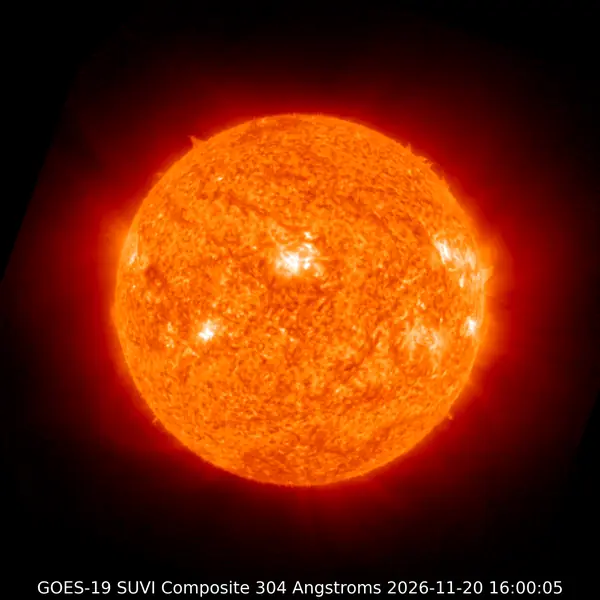
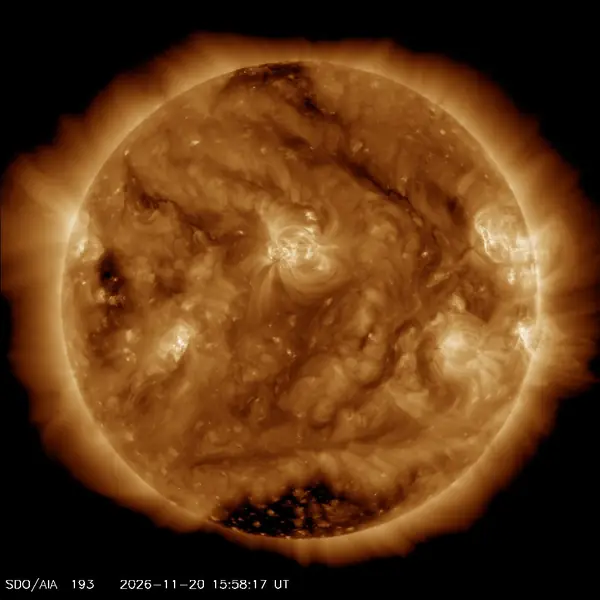
Left shows the cooler lower atmosphere and erupting filaments (GOES-19 SUVI 304 Å). Right shows the million-degree outer corona and dark coronal holes that send fast solar wind toward Earth (NASA SDO AIA 193 Å).
The Sun right now
Dated Space-Weather & Forecast Brief Observed G0 / outlook G0
Forecast source policy: following a recorded Nov 6 disagreement, this site provisionally uses NOAA's issued 3-day text for forecast blocks. The 24-hour issue-age limit is a site safety cutoff, not a NOAA freshness standard. Missing or invalid forecast data means unavailable, not G0.
reported provisional 3h Kp, UTC block start 2026-11-20 12:00: 0.33. Observed G is from NOAA scales at Fri Nov 20, 16:08 UTC · 11:08 AM ET · 9:08 AM MT · 8:08 AM PT. Outlook uses the available forecast blocks (up to 48 hours), not an observed storm. The provisional block estimate and minute-by-minute estimate are different products.
Forecast source: NOAA issued 3-day text; issued Fri Nov 20, 12:30 UTC · 7:30 AM ET · 5:30 AM MT · 4:30 AM PT, retrieved 2026-11-20T16:09:29+00:00. A historical source disagreement was recorded Nov 6: Nov 7 00–03 UTC (Nov 6 7–10 PM EST) was Kp 5 in text but 4 in JSON; 03–06 UTC (10 PM Nov 6–1 AM Nov 7 EST) was 4 in text but 5 in JSON. Predictions here use the text, without shifting timestamps.
Auto-updated Fri Nov 20, 16:09 UTC · 11:09 AM ET · 9:09 AM MT · 8:09 AM PTTimestamped summary card combining NOAA SWPC planetary Kp, L1 solar wind, Shue et al. (1998) magnetopause standoff distance, and estimated equatorward aurora horizon reach. Free to link, download or embed (CC0 public domain).
Geomagnetic field now quiet
Field quiet; magnetosphere somewhat expanded under low-pressure solar wind.
| Kp (latest 3 h) | 0.33: below storm level interval from Fri Nov 20, 12:00 UTC · 7:00 AM ET · 5:00 AM MT · 4:00 AM PT |
|---|---|
| Dst | -8 nT: quiet (above -30 nT) Fri Nov 20, 15:00 UTC · 10:00 AM ET · 8:00 AM MT · 7:00 AM PT |
| Solar wind | 377 km/s, 1.77 p/cm³ Fri Nov 20, 16:04 UTC · 11:04 AM ET · 9:04 AM MT · 8:04 AM PT |
| IMF Bz / Bt | -1.4 nT (southward) / 5.8 nT Fri Nov 20, 16:05 UTC · 11:05 AM ET · 9:05 AM MT · 8:05 AM PT |
| Magnetopause | 12.9 Earth radii (dynamic pressure 0.42 nPa) |
| GOES-19 Hp | 108.7 nT (6-h low 85.2 nT) No sign of a magnetopause crossing in the last 6 h Fri Nov 20, 16:06 UTC · 11:06 AM ET · 9:06 AM MT · 8:06 AM PT |
Data: NOAA SWPC planetary K-index; Kyoto WDC realtime (quicklook) Dst, via NOAA SWPC (provisional); NOAA SWPC real-time solar wind (spacecraft: SOLAR1; 10-minute means); NOAA SWPC GOES magnetometer. NOAA data are U.S. government works in the public domain.
Solar Cycle 25 progression (NOAA SWPC / WDC-SILSO): smoothed sunspot peak so far is 160.9 (2024-10), compared with Cycle 24's peak of 116.4 (2014-04). Latest monthly sunspot number: 45.7 (2026-10, preliminary). Related: Aurora Tonight & 28 State/Region Guides · Free Embeddable Space Weather Widget · Geomagnetic Shield Model · Storm Log.
Embed This Live Space Weather & Magnetic Shield Card on Your Site
Run an astronomy club, weather blog, dark-sky park page, or science classroom? Copy our free, cookie-free live widget in Dark, Light, or Compact mode.
Get Free Embed Code →Raw Satellite Telemetry & Recent Solar Activity
L1 Solar Wind & IMF Telemetry
| Solar wind speed | 378 km/s |
|---|---|
| Proton density | 1.83 protons/cm³ |
| Total field strength (Bt) | 6 nT |
| North–South field (Bz GSM) | -2 nT |
Updated 2026-11-20T16:05:00Z (spacecraft: SOLAR1). Data: NOAA SWPC.
Recent GOES X-Ray Flares & SWPC Bulletins
NOAA's most recent bulletins, including minor and ongoing notices; the Impact Level above reflects current conditions.
Nov 19, 01:18 UTC · 8:18 PM ET, Nov 18 · 6:18 PM MT, Nov 18 · 5:18 PM PT, Nov 18 EXTENDED WARNING: Geomagnetic K-index of 4 expected
Times in UTC
Space Weather Message Code: WARK04
Serial Number: 5457
Issue Time: 2026 Nov 19 0118 UTC

EXTENDED WARNING: Geomagnetic K-index of 4 expected
Extension to Serial Number: 5456
Valid From: 2026 Nov 19 0040 UTC
Now Valid Until: 2026 Nov 19 0900 UTC
Warning Condition: Persistence


NOAA Space Weather Scale descriptions can be found at
www.swpc.noaa.gov/noaa-scales-explanation

Potential Impacts: Area of impact primarily poleward of 65 degrees Geomagnetic Latitude.
Induced Currents - Weak power grid fluctuations can occur.
Aurora - Aurora may be visible at high latitudes such as Canada and Alaska.
Nov 19, 01:08 UTC · 8:08 PM ET, Nov 18 · 6:08 PM MT, Nov 18 · 5:08 PM PT, Nov 18 ALERT: Geomagnetic K-index of 5
Times in UTC
Space Weather Message Code: ALTK05
Serial Number: 2063
Issue Time: 2026 Nov 19 0108 UTC

ALERT: Geomagnetic K-index of 5
Threshold Reached: 2026 Nov 19 0105 UTC
Synoptic Period: 0000-0300
Active Warning: YES
Noaa Scale: G1 - Minor
Comment:

NOAA Scale: G1 - Minor

NOAA Space Weather Scale descriptions can be found at
www.swpc.noaa.gov/noaa-scales-explanation

Potential Impacts: Area of impact primarily poleward of 60 degrees Geomagnetic Latitude.
Induced Currents - Weak power grid fluctuations can occur.
Spacecraft - Minor impact on satellite operations possible.
Aurora - Aurora may be visible at high latitudes, i.e., northern tier of the U.S. such as northern Michigan and Maine.
Nov 19, 01:00 UTC · 8:00 PM ET, Nov 18 · 6:00 PM MT, Nov 18 · 5:00 PM PT, Nov 18 WARNING: Geomagnetic K-index of 5 expected
Times in UTC
Space Weather Message Code: WARK05
Serial Number: 2276
Issue Time: 2026 Nov 19 0100 UTC

WARNING: Geomagnetic K-index of 5 expected
Valid From: 2026 Nov 19 0055 UTC
Valid To: 2026 Nov 19 0300 UTC
Warning Conditions: Onset
Noaa Scale: G1 - Minor
Comment:

NOAA Scale: G1 - Minor

NOAA Space Weather Scale descriptions can be found at
www.swpc.noaa.gov/noaa-scales-explanation

Potential Impacts: Area of impact primarily poleward of 60 degrees Geomagnetic Latitude.
Induced Currents - Weak power grid fluctuations can occur.
Spacecraft - Minor impact on satellite operations possible.
Aurora - Aurora may be visible at high latitudes, i.e., northern tier of the U.S. such as northern Michigan and Maine.
Nov 19, 00:46 UTC · 7:46 PM ET, Nov 18 · 5:46 PM MT, Nov 18 · 4:46 PM PT, Nov 18 ALERT: Geomagnetic K-index of 4
Times in UTC
Space Weather Message Code: ALTK04
Serial Number: 2698
Issue Time: 2026 Nov 19 0046 UTC

ALERT: Geomagnetic K-index of 4
Threshold Reached: 2026 Nov 19 0042 UTC
Synoptic Period: 0000-0300
Active Warning: YES
Comment:

NOAA Space Weather Scale descriptions can be found at
www.swpc.noaa.gov/noaa-scales-explanation

Potential Impacts: Area of impact primarily poleward of 65 degrees Geomagnetic Latitude.
Induced Currents - Weak power grid fluctuations can occur.
Aurora - Aurora may be visible at high latitudes such as Canada and Alaska.
Strongest GOES X-ray flares (last 7 days)
- Nov 19, 13:24 UTC · 8:24 AM ET · 6:24 AM MT · 5:24 AM PT class M2.4
- Nov 17, 21:39 UTC · 4:39 PM ET · 2:39 PM MT · 1:39 PM PT class M1.7
- Nov 19, 13:59 UTC · 8:59 AM ET · 6:59 AM MT · 5:59 AM PT class M1.1
- Nov 17, 15:49 UTC · 10:49 AM ET · 8:49 AM MT · 7:49 AM PT class M1.1
- Nov 20, 11:30 UTC · 6:30 AM ET · 4:30 AM MT · 3:30 AM PT class C9.6
NASA DONKI CMEs (build snapshot 2026-11-06 to 2026-11-20, fetched Nov 20, 16:09 UTC · 11:09 AM ET · 9:09 AM MT · 8:09 AM PT):
- Nov 19, 18:30 UTC · 1:30 PM ET · 11:30 AM MT · 10:30 AM PT 321 km/s · Faint CME observed to the NE in GOES CCOR-1 and SOHO LASCO C3, too faint in LASCO C2 and ongoing STEREO A COR2 data gap, and is observed mor · DONKI
- Nov 19, 15:36 UTC · 10:36 AM ET · 8:36 AM MT · 7:36 AM PT 425 km/s · Narrow CME visible to the SE in SOHO LASCO C2/C3 and GOES CCOR-1 imagery. There is a data gap in STEREO A COR2 imagery starting at 2026-11-1 · DONKI
- Nov 19, 13:26 UTC · 8:26 AM ET · 6:26 AM MT · 5:26 AM PT 376 km/s · This CME is faintly visible to the east in SOHO LASCO C2 imagery. This CME is not clearly visible in other coronagraph imagery. No source is · DONKI
- Nov 19, 08:09 UTC · 3:09 AM ET · 1:09 AM MT · 12:09 AM PT 364 km/s · CME seen to the NE in STEREO A COR2 and GOES CCOR-1 imagery. The CME can also be faintly seen to the NE in SOHO LASCO C2 before a real-time · DONKI