A magnetic pole reversal would cause mass extinction or catastrophe
Status: Leading Edge / ContestedVerdict: Open question
The claim: Geomagnetic reversals or excursions trigger global environmental crises, including extinctions.
Where the evidence stands: Scientists are actively debating this. A high-profile 2021 Science study (Cooper et al.) argued that a brief magnetic flip 42,000 years ago (the Laschamp event) weakened the ozone layer and contributed to Ice Age extinctions. Critics in Science and the USGS counter that the fossil record across 183 past magnetic reversals shows no pattern of mass extinctions. We grade it Leading Edge — Open question.
Background
Earth's magnetic shield deflects solar storms and cosmic rays. In Earth in Upheaval (1955, Ch. IX), Immanuel Velikovsky argued from reversed basalt lava flows and Ice Age bone beds that a sudden shift of Earth's axis, with a magnetic reversal, coincided with sudden extinctions. Cox, Doell, and Dalrymple (1963) later dated reversed lavas and showed that they record flips of Earth's magnetic field over very long times. Today, researchers debate whether temporary weak-field periods (like the Laschamp event 41,000–42,000 years ago, when the shield dropped to ~10% of normal) altered upper-air ozone and weather enough to stress Ice Age animals and humans.
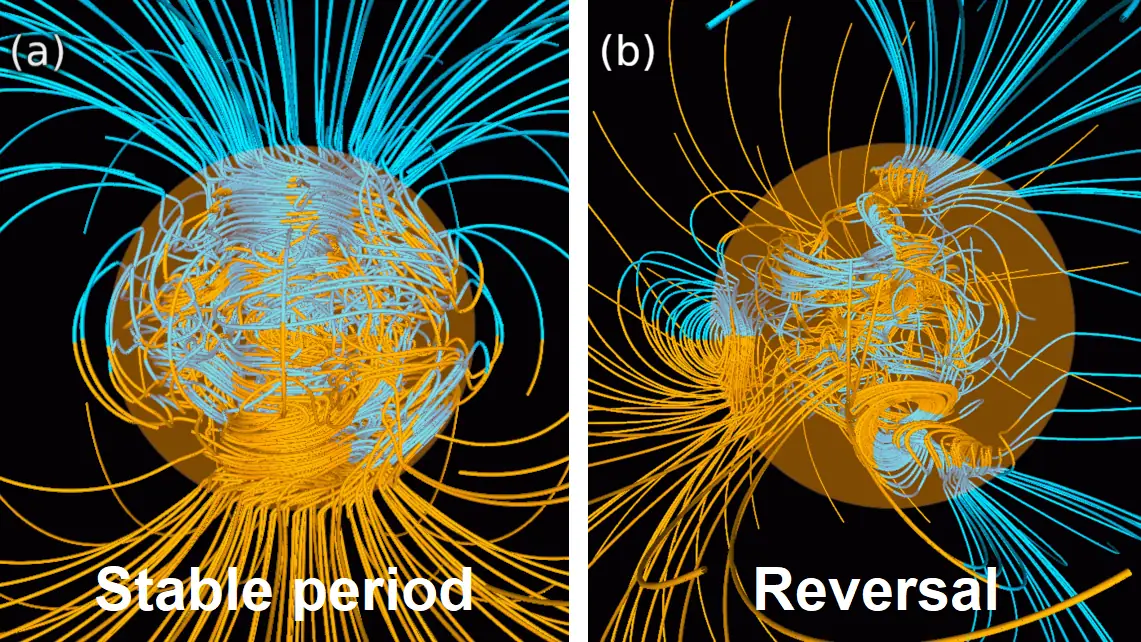
A simple dipole field in a stable period compared with a complex field during a reversal. Image: Quatus, CC BY-SA 4.0, via Wikimedia Commons. Resized.
⚖ Proponents' main arguments and cited evidence
*The 2021 kauri-tree Laschamp study (Science):* Cooper et al. (2021) used ancient New Zealand kauri trees to track the radiocarbon spike when Earth's field dropped below 10% around 42,000 years ago. Their climate model showed extra cosmic rays and solar protons could damage ozone, shift wind belts, and stress megafauna. [1]
*Authors' 2021 reply in Science:* Cooper and colleagues replied to critics that climate shifts during the Laschamp event show up clearly in Southern Hemisphere and Pacific records even when Greenland ice looks quieter. [2]
Long-term reversal cycle studies. Raup (1985) analyzed 165 million years of magnetic reversals in Nature to test whether reversal clusters line up with biological turnovers. [3]
Discovery of the Levantine Iron Age spike. Modern archaeomagnetism on in-place Near Eastern kilns and copper slag mounds discovered the Levantine Iron Age Geomagnetic Anomaly (the first 350 years of the first millennium BCE; Shaar et al. 2017), when regional magnetic strength spiked to over twice today's level. A spike recorded in the copper slag is dated to the 12th to 9th centuries BCE (Ben-Yosef et al. 2009). [10][11]
🔬 The mainstream scientific position and its evidence
USGS — No link between reversals and mass extinctions. The US Geological Survey notes that magnetic flips happen every few hundred thousand years (183 times in 83 million years), while major mass extinctions happen tens of millions of years apart with no matching pattern. [4]
NASA — Fossils through the 773,000-year-ago flip show no crisis. NASA points out that plant and animal fossils across the last full reversal (Matuyama–Brunhes) show no mass die-off. [5]
*Critics in Science (Hawks 2021):* Anthropologist John Hawks noted that Neanderthal and megafaunal extinctions were spread across tens of thousands of years rather than clustering at 42,000 years ago. [6]
*Critics in Science (Picin et al. 2021):* Picin and colleagues pointed out that an earlier magnetic excursion 114,000 years ago (the Blake event) caused no harm to Neanderthals, early modern humans, or Australian animals. [7]
Radiometric dating places full flips in the liquid core (~773 ka). K–Ar and Ar–Ar dating (Cox et al. 1963; Singer et al. 2019) proved that full magnetic reversals unfold over thousands of years in the liquid outer core—with the last full reversal 773,000 years ago—not as a sudden crust or axis flip in 1500–700 BCE. [9][12]
What evidence would help settle it
What would settle it: high-resolution ice-core and lake-sediment records across multiple magnetic excursions (Laschamp at 41 ka, Mono Lake at 34 ka, Blake at 114 ka) testing whether ozone loss or climate shifts consistently appear whenever the magnetic field dips.
Primary Scientific Sources (12)
Cooper, A. et al. (2021). A global environmental crisis 42,000 years ago. Science. doi:10.1126/science.abb8677proponent
Cooper, A. et al. (2021). Response to Comment on 'A global environmental crisis 42,000 years ago'. Science. doi:10.1126/science.abi9756proponent
Raup, D. M. (1985). Magnetic reversals and mass extinctions. Nature. doi:10.1038/314341a0proponent
Hawks, J. (2021). Comment on 'A global environmental crisis 42,000 years ago'. Science. doi:10.1126/science.abh1878critic/test
Picin, A. et al. (2021). Comment on 'A global environmental crisis 42,000 years ago'. Science. doi:10.1126/science.abi8330critic/test
Velikovsky, I. (1955). Earth in Upheaval (Ch. VIII 'Poles Displaced'; Ch. IX 'Axis Shifted', section 'Magnetic Poles Reversed'; Ch. I–V). Doubleday / Paradigma Ltd (2009 ed., ISBN 9781906833121). Library record (Open Library). https://openlibrary.org/works/OL1109248Wproponent
Cox, A., Doell, R. R. & Dalrymple, G. B. (1963). Geomagnetic Polarity Epochs and Pleistocene Geochronometry. Nature. doi:10.1038/1981049a0data
Ben-Yosef, E. et al. (2009). Geomagnetic intensity spike recorded in high resolution slag deposit in Southern Jordan. Earth and Planetary Science Letters. doi:10.1016/j.epsl.2009.09.001data
Shaar, R. et al. (2017). Further evidence of the Levantine Iron Age geomagnetic anomaly from Georgian pottery. Geophysical Research Letters. doi:10.1002/2016gl071494data
Singer, B. S. et al. (2019). Synchronizing volcanic, sedimentary, and ice core records of Earth's last magnetic polarity reversal. Science Advances. doi:10.1126/sciadv.aaw4621data
The Spinning Magnet: The Electromagnetic Force That Created the Modern World—and Could Destroy It
Alanna Mitchell · ISBN 9781101985182
Science journalist Alanna Mitchell visits the geophysicists studying Earth's molten iron core, the growing weak spot over the South Atlantic. The temporary magnetic flip 41,000 years ago. Explores what a future flip would do to satellites and power grids.
Why this book matters to both sides
Bridges both sides of the magnetic pole-shift debate by combining mainstream satellite data with an honest look at how a weak magnetic shield exposes modern technology to solar storms.
Award-winning geophysicist Ronald Merrill explains how churning liquid iron 1,800 miles underfoot creates Earth's magnetic shield. He also explains why magnetic pole flips are completely different from the solid planet tipping over.
Why this book matters to both sides
Crucial for separating the three ideas often mixed up under 'pole shift': magnetic flips in the liquid core, slow tipping of the whole planet over millions of years, and rapid crust-slip claims.
Leaving out ancient folklore, Velikovsky's 1955 book gathered real geological puzzles—frozen Alaskan mammoth beds, polar coal seams, and reversed-polarity lava rocks (Ch. IX)—to argue against slow-and-steady geology.
Why this book matters to both sides
A 1955 book that proposed sudden pole shifts. It cited reversed lavas, which later work showed are magnetic flips in the core. Its crust-slip timeline was not supported.
Earth Under Fire: Humanity's Survival of the Ice Age
Paul A. LaViolette · ISBN 9781591430520
Sets out the Leading Edge 'galactic superwave' hypothesis. LaViolette argues that cosmic-ray blasts from the center of our galaxy periodically push cosmic dust into the solar system, triggering giant solar flares and Ice Age floods.
Why this book matters to both sides
Presents the cosmic-ray and solar-dust catastrophe model often cited alongside solar micronova claims. That readers can compare against polar ice-core beryllium-10 records.
FTC affiliate disclosure: Book links above go to Bookshop.org (Affiliate ID 130218, shop Search for the Truth), which supports independent bookstores. If you buy through one of these links, Solar Evidence earns a 10% commission at no extra cost to you. All affiliate links carry rel="sponsored nofollow noopener". Every recommended title is verified in print and meets our 4.3+/5 reader or landmark scholarly reputation standard; commissions never influence our evidence labels. Affiliate policy.
Interest signal: Wikipedia 'Laschamp event' averaged 3,623 views/month (Oct 2025-Sep 2026). Sources were checked against Crossref/publisher pages on 2026-10-26. This entry presents a debated idea neutrally: proponents' case first, then the mainstream position, in our own words. It is not a prediction and not safety advice. Labels describe the claim, not the people who hold it. Disclaimer.