Status: Not supported by evidenceVerdict: Not supported by evidence
The claim: Periodically, Earth's core and mantle unhook, and the outer crust flips 104° to a new spin position before flipping back. The author argues this causes global floods recorded in ancient monuments.
Where the evidence stands: We found no peer-reviewed paper that presents or supports ECDO (checked Fri Nov 13, 2026). Its central step is a 104° flip of the mantle and crust in hours to days. That conflicts with how Earth is measured to spin, and with polar wander rates measured in rocks, which are degrees per million years.
Short summary
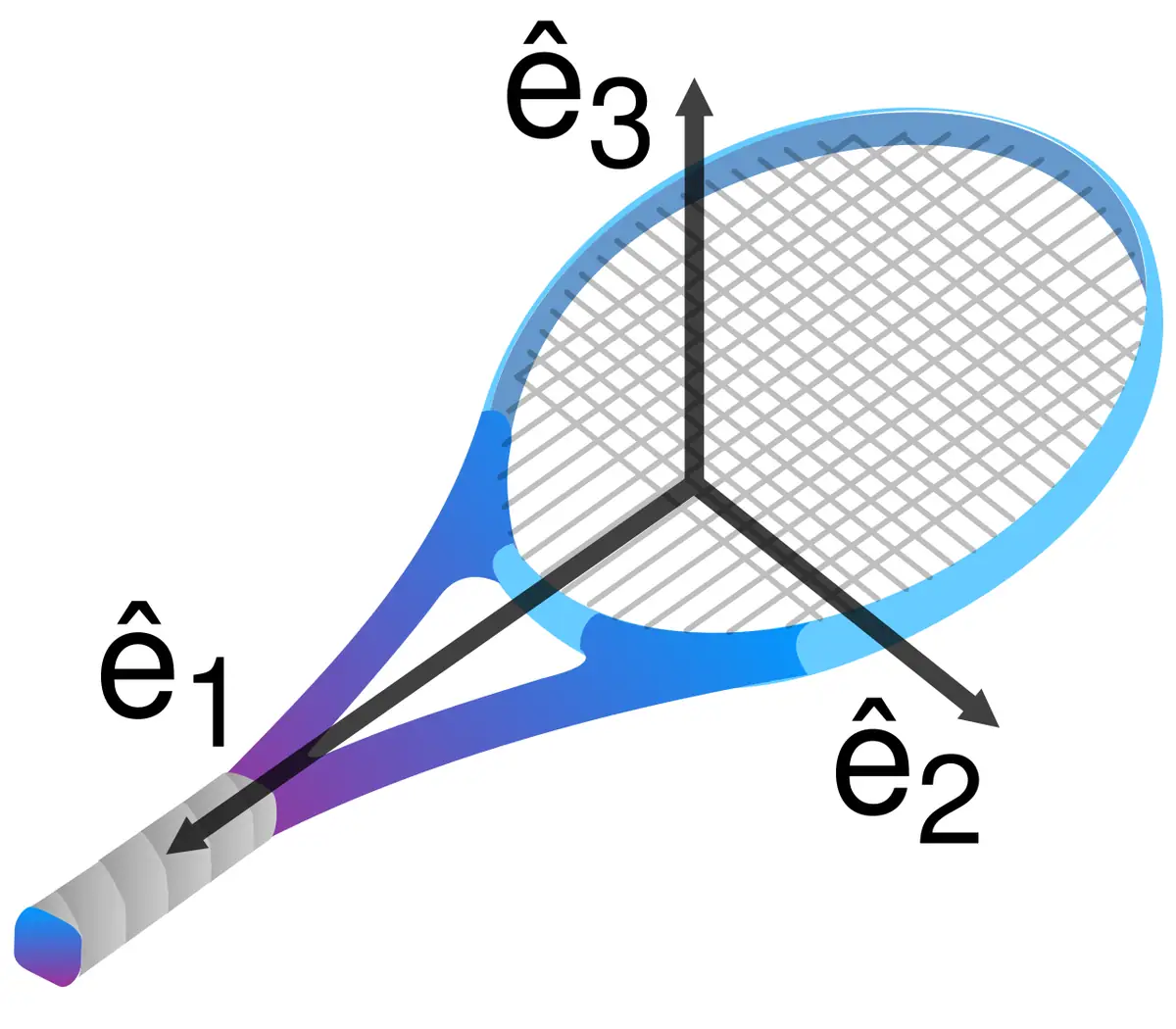
ECDO stands for 'Exothermic Core-Mantle Decoupling - Dzhanibekov Oscillation.' One author set it out in blog posts and a 2026 book. We found no sign that it has appeared in a peer-reviewed journal. The author says the core loses its magnetic grip as the field weakens, and that material shed from the core into the deepest mantle layer (D″) lubricates the break. The mantle and crust then tip 104 degrees. The author names the Dzhanibekov effect, the flip of a spinning wingnut in space, as the path of the flip, not its cause. A body flips that way only about its middle axis. Earth spins about its polar axis, the axis that is hardest to turn. Spin about that axis is stable. Polar wander found in rocks runs at about 1 to a few degrees per million years, with one rapid episode above 5. A 104-degree turn in hours would be billions of times faster. Greenland ice layers and tree rings, counted year by year, run unbroken through thousands of years. A weaker magnetic field, the South Atlantic Anomaly and warmer oceans are real. None of them shows that the crust has flipped.
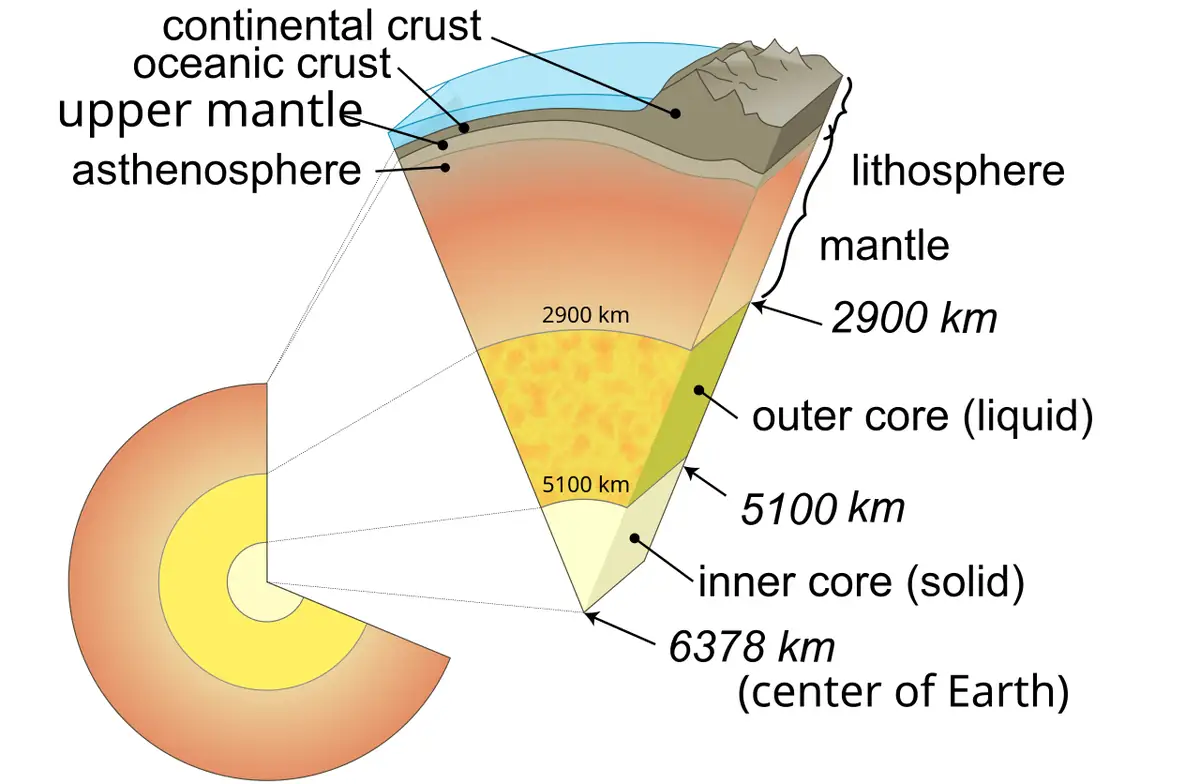
The intermediate-axis effect: a body spun about its middle axis flips, but spin about the longest or shortest axis is stable. Image: cmglee, Franck Doucet, CC BY-SA 4.0, via Wikimedia Commons. Resized.Earth's interior layers, after a USGS diagram. Image: After USGS; derivative work by Srimadhav, Public domain, via Wikimedia Commons. Resized.
The evidence at a glance
Peer review: none found. We found no journal paper that presents or supports ECDO (checked Fri Nov 13, 2026). [1]
Stability: Earth spins about the axis with the largest moment of inertia (IERS 2010; H = 0.003274), and spin about that axis is stable. The spin axis follows that axis as the mantle slowly moves (Steinberger et al. 2017). [7][8]
Speed: true polar wander is about 1 degree per million years or less in most eras (Tsai & Stevenson 2007; Steinberger & Torsvik 2008). One rapid episode, 832 to 821 million years ago, is constrained at more than 5 degrees per million years (Fu et al. 2022). [9][10][11]
Records: counted Greenland ice layers (Vinther et al. 2006) and tree-ring chronologies (Friedrich et al. 2004; Reinig et al. 2021) run unbroken through thousands of years. The tree-ring series reach back more than 12,000 years. [12][13][14]
Magnetism: reversals and excursions, such as the Laschamp event about 41,000 to 42,000 years ago, are changes in the core's magnetic field over hundreds to thousands of years. They are not crust motion (NASA; Cooper et al. 2021; Mukhopadhyay et al. 2025). [2][15][16]
What the author points to, and what the records show
The 104° flip. The author says the mantle and crust pivot about 104° along the 31st meridian east when magnetic coupling at the core-mantle boundary weakens. Core and mantle do trade a little spin. Day length varies by milliseconds or less over years to decades, partly through this exchange (Holme & de Viron 2013). That is coupling, not a flip. Today's small polar motion is mostly explained by measured shifts of ice, water and mass (Adhikari & Ivins 2016). Seismic data show isolated patches, not a global liquid layer, at the base of the mantle (Garnero & McNamara 2008). [1][17][6][18]
A weaker magnetic field and warmer oceans. The field has lost about 9% of its strength in 200 years, but NASA notes it is still about as strong as it has been in the past 100,000 years and about twice its million-year average. Reversals happen in the liquid core, not the crust. [1][2]
Flood stories, Giza and the Y-chromosome bottleneck. The author cites water erosion at Giza and a drop in male-line diversity about 5,000 to 7,000 years ago. Zeng et al. (2018) propose that cultural hitchhiking and competition between patrilineal kin groups can explain a drop of this kind. Their model needs no flood. Flood stories and Giza weathering are covered on our sister site. We know of no link between them and a crust flip. [1][3]
Polar wander is real in deep time. The solid Earth has turned slowly over millions of years (Kirschvink et al. 1997; Wang & Mitchell 2023). A study published Oct 1, 2026 reports episodes of rapid polar wander, but 'rapid' there means millions of years (Domeier et al. 2026). That is not a flip in hours. [4][5][19]
What remains unknown
The make-up of the deepest mantle, how much spin the core and mantle trade, and how fast true polar wander can go in some eras. The author says material shed from the core lubricates the base of the mantle and helps the flip along. We found no published model of that step. The weakening magnetic field and the South Atlantic Anomaly are real and still studied. Neither is a sign of a crust flip.
Where the claim comes from (the proponents' own pages and books)
These are the claim's own sources. They show what is claimed. They are not evidence for it.
Zeng, T. C., Aw, A. J. & Feldman, M. W. (2018). Cultural hitchhiking and competition between patrilineal kin groups explain the post-Neolithic Y-chromosome bottleneck. Nature Communications. doi:10.1038/s41467-018-04375-6background
Kirschvink, J. L. et al. (1997). Evidence for a large-scale reorganization of Early Cambrian continental masses by inertial interchange true polar wander. Science. doi:10.1126/science.277.5325.541background
Wang, C. & Mitchell, R. N. (2023). True polar wander in the Earth system. Science China Earth Sciences (open access review). doi:10.1007/s11430-022-1105-2background
Adhikari, S. & Ivins, E. R. (2016). Climate-driven polar motion: 2003-2015. Science Advances. doi:10.1126/sciadv.1501693data
IERS Conventions (2010), IERS Technical Note No. 36 (Petit & Luzum, eds.). Defines the reference axis as the axis of maximum moment of inertia and gives the Earth's dynamical ellipticity. https://iers-conventions.obspm.fr/content/tn36.pdfdata
Steinberger, B., Seidel, M. & Torsvik, T.H. (2017). Limited true polar wander as evidence that Earth's nonhydrostatic shape is persistently triaxial. Geophysical Research Letters. doi:10.1002/2016GL071937data
Tsai, V.C. & Stevenson, D.J. (2007). Theoretical constraints on true polar wander. Journal of Geophysical Research: Solid Earth. doi:10.1029/2005JB003923background
Steinberger, B. & Torsvik, T.H. (2008). Absolute plate motions and true polar wander in the absence of hotspot tracks. Nature. doi:10.1038/nature06824data
Fu, H. et al. (2022). Secular change of true polar wander over the past billion years. Science Advances. doi:10.1126/sciadv.abo2753data
Vinther, B.M. et al. (2006). A synchronized dating of three Greenland ice cores throughout the Holocene. Journal of Geophysical Research: Atmospheres. doi:10.1029/2005JD006921data
Friedrich, M. et al. (2004). The 12,460-Year Hohenheim Oak and Pine Tree-Ring Chronology from Central Europe—A Unique Annual Record for Radiocarbon Calibration and Paleoenvironment Reconstructions. Radiocarbon. doi:10.1017/S003382220003304Xdata
Reinig, F. et al. (2021). Precise date for the Laacher See eruption synchronizes the Younger Dryas. Nature. doi:10.1038/s41586-021-03608-xdata
Cooper, A. et al. (2021). A global environmental crisis 42,000 years ago. Science. doi:10.1126/science.abb8677data
Mukhopadhyay, A. et al. (2025). Wandering of the auroral oval 41,000 years ago. Science Advances. doi:10.1126/sciadv.adq7275data
Holme, R. & de Viron, O. (2013). Characterization and implications of intradecadal variations in length of day. Nature. doi:10.1038/nature12282data
Garnero, E.J. & McNamara, A.K. (2008). Structure and Dynamics of Earth's Lower Mantle. Science. doi:10.1126/science.1148028background
Domeier, M. et al. (2026). Quadrupolar sea level fluctuations reveal episodes of rapid polar wander. Science. doi:10.1126/science.aec8423data
Award-winning geophysicist Ronald Merrill explains how churning liquid iron 1,800 miles underfoot creates Earth's magnetic shield. He also explains why magnetic pole flips are completely different from the solid planet tipping over.
Why this book is listed
Crucial for separating the three ideas often mixed up under 'pole shift': magnetic flips in the liquid core, slow tipping of the whole planet over millions of years, and rapid crust-slip claims.
The Spinning Magnet: The Electromagnetic Force That Created the Modern World—and Could Destroy It
Alanna Mitchell · ISBN 9781101985182
Science journalist Alanna Mitchell visits the geophysicists studying Earth's molten iron core, the growing weak spot over the South Atlantic. The temporary magnetic flip 41,000 years ago. Explores what a future flip would do to satellites and power grids.
Why this book is listed
Explains the science of Earth's magnetic field and what a future magnetic flip could mean for satellites and power grids, using satellite data.
FTC affiliate disclosure: Book links above go to Bookshop.org (Affiliate ID 130218, shop Search for the Truth), which supports independent bookstores. If you buy through one of these links, Solar Evidence earns a 10% commission at no extra cost to you. All affiliate links carry rel="sponsored nofollow noopener". Every recommended title is verified in print and meets our 4.3+/5 reader or landmark scholarly reputation standard; commissions never influence our evidence labels. Affiliate policy.
Interest signal: No Wikipedia article exists for ECDO; 'True polar wander' averaged 1,100 views/month (Oct 2025-Sep 2026). Sources were checked against Crossref/publisher pages on 2026-11-13. This entry sums up the evidence in our own words. It is not a prediction and not safety advice. Labels describe the claim, not the people who hold it. Disclaimer.