Educational reference only—not for operational or safety decisions. For official alerts use NOAA SWPC.
Claims › The Sun & space weather › The 'solar micronova' / solar flash
The 'solar micronova' / solar flash
Status: Leading Edge / Contested
The claim: The Sun undergoes a recurring 'micronova' outburst, roughly every 12,000 years, that will soon strike Earth and cause a global catastrophe alongside a geomagnetic pole shift.
Why this label: Astronomers did discover 'micronovae' in 2022, but only on dead, ultra-dense white-dwarf stars that pull gas off a companion star. Our Sun is a normal single star. While tree rings prove the Sun can unleash rare 'superflares' hundreds of times bigger than modern storms, there is no evidence of a nova explosion or a 12,000-year clock.
Promoted mainly on YouTube by SpaceWeatherNews (Suspicious0bservers) and earlier by writer Doug Vogt, the solar micronova hypothesis claims the Sun explodes in a recurring flash every 12,000 years, flipping Earth's poles. While astronomers reject a nova-style explosion on our Sun, tree-ring and ice-core discoveries since 2012 have proven that the Sun does produce rare extreme radiation storms ('Miyake events') far larger than anything in the modern space age.
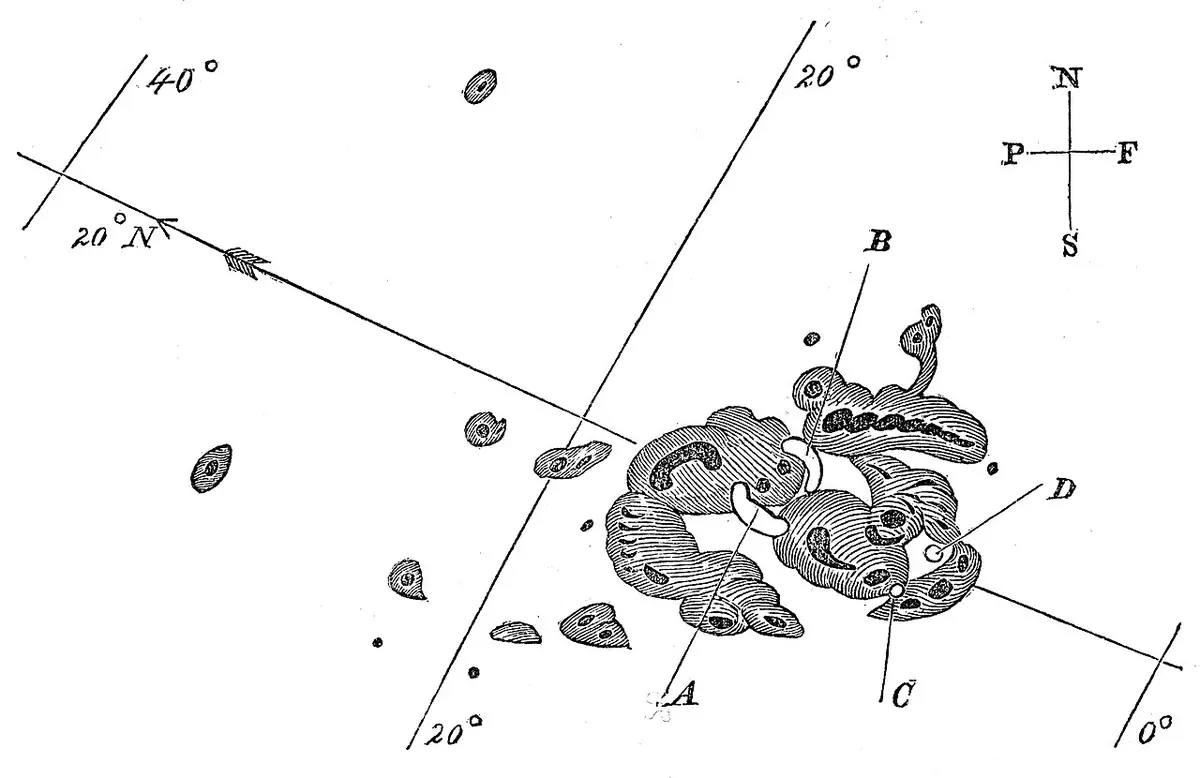
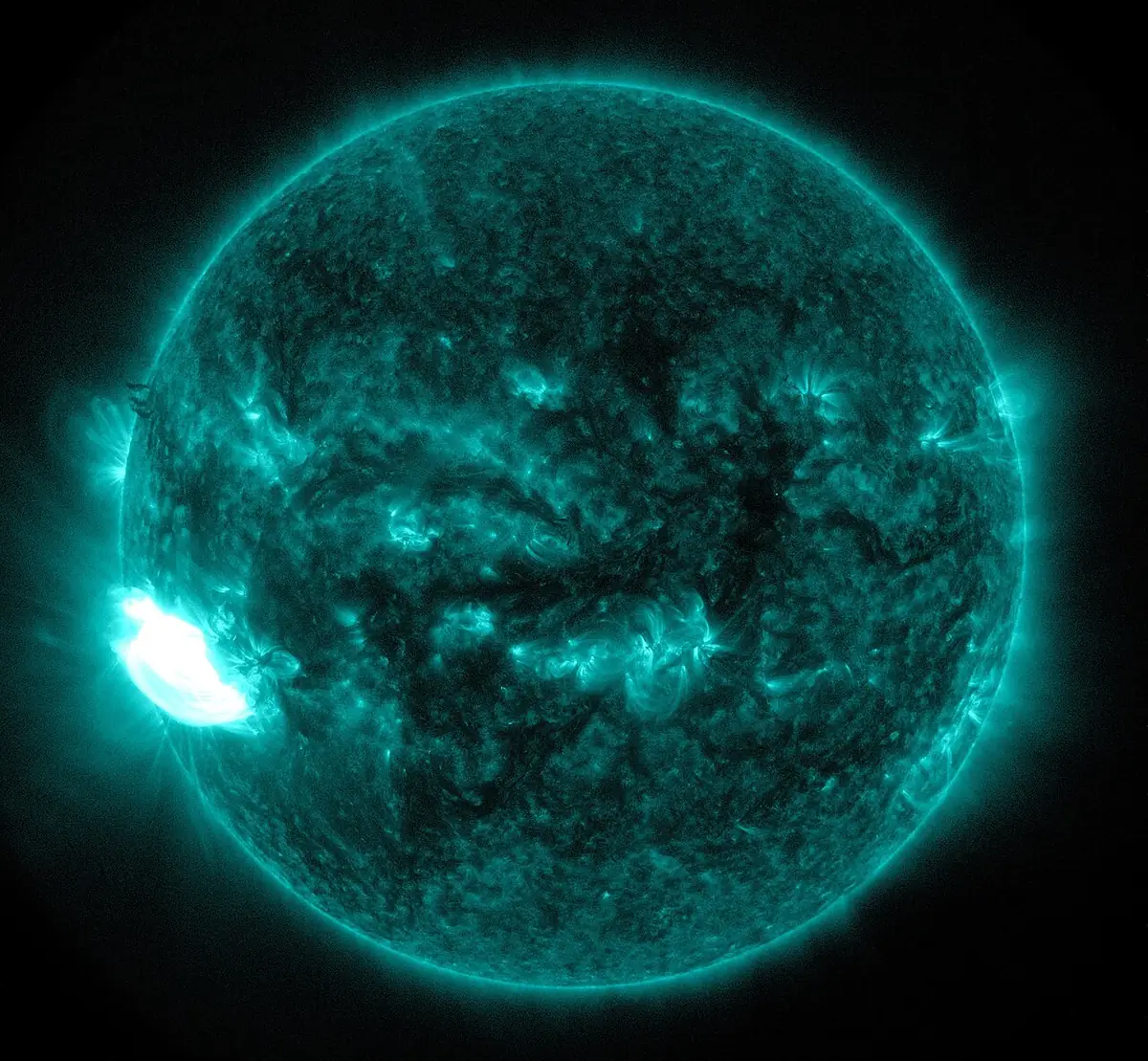
Richard Carrington's drawing of the sunspot group that produced the white-light flare of 1 September 1859. Image: Richard Christopher Carrington, Public domain, via Wikimedia Commons. Resized.An X-class flare seen by NASA's Solar Dynamics Observatory. Image: NASA Goddard Space Flight Center / SDO, Public domain, via Wikimedia Commons. Resized.
✓ Evidence and arguments for
Proponents point to galactic dust & new stellar bursts. Proponents argue that interstellar dust sheets can dump material onto the Sun and point to recent discoveries of unusual stellar outbursts. [1]
Sun-like stars produce superflares. A 2024 Science study of 56,450 Sun-like stars found that massive 'superflares' (10 to 1,000 times larger than the 1859 Carrington flare) happen roughly once a century on stars like ours. [4]
🔬 Evidence and arguments against
Real micronovae require a dead white-dwarf star. The micronovae discovered in 2022 (Scaringi et al., Nature) are thermonuclear flashes on dead white dwarfs stealing gas from a binary partner. Our Sun has no companion star and cannot undergo white-dwarf bursts. [2][3]
Superflares are scaled-up normal flares, not novae. The 2024 Science study showed that stellar superflares follow the exact same power curve as normal solar flares. They are giant magnetic flares, not shell explosions. [4]
No 12,000-year clock shows up in the record so far. A 2026 review by Usoskin lists five confirmed extreme solar particle events and four unconfirmed candidates. It finds no regular cycle in when they happen during the Holocene (the last 11,700 years). The confirmed events are about 220 to 4,600 years apart. Only about 2,000 years (16%) of the Holocene have been measured year by year, so more may be found. The largest radiocarbon spike, at 14,300 cal BP (about 12,350 BCE; Bard et al. 2023), is still awaiting independent confirmation. It is about 1,500 years older than the Younger Dryas boundary layer that Kennett et al. (2015) date to 12,835–12,735 cal BP. [5][6][7]
Open questions & what would change the label
Just how big can a solar superflare get on our Sun? See our full October 2026 Evidence Review right below on this page for the latest tree-ring, ice-core, and stellar-superflare data.
Vasilyev, V. et al. (2024). Sun-like stars produce superflares roughly once per century. Science. doi:10.1126/science.adl5441background
Usoskin, I. G. (2026). Extreme solar events: An update. Proceedings of the International Astronomical Union 20 (Symposium S388; volume dated 2024): 267–276. Published online 28 May 2026. doi:10.1017/S1743921324001388background
Bard, E. et al. (2023). A radiocarbon spike at 14 300 cal yr BP in subfossil trees provides the impulse response function of the global carbon cycle during the Late Glacial. Phil. Trans. R. Soc. A 381: 20220206. doi:10.1098/rsta.2022.0206background
Kennett, J. P. et al. (2015). Bayesian chronological analyses consistent with synchronous age of 12,835–12,735 Cal B.P. for Younger Dryas boundary on four continents. PNAS 112(32). doi:10.1073/pnas.1507146112proponent
PNAS (8 Jul 2024). Correction to Supporting Information for Kennett et al. (2015): early versions of the OxCal code were printed for some sites; authors state figures, tables and conclusions are unchanged. doi:10.1073/pnas.2411213121notice
Evidence review (October 2026)
Date checked: 22 Oct 2026. The claim entry above is unchanged; its label remains Leading Edge / Contested. This review gives newer observations slightly more weight than older textbook positions, keeps measured facts separate from inference, and gives the Leading Edge idea a fair hearing. Each statement is tagged MeasuredInferred or Hypothesis. Preprints are marked Preprint. Source numbers [R1]–[R17] refer to the list at the end of this review.
Bottom line
Newer data keep showing that the Sun is capable of more than the textbook picture of a decade ago allowed. That supports the core instinct behind the micronova idea: the Sun can, rarely, be far more violent than anything seen in the instrument era. The specific model (a recurring, nova-like solar outburst on a roughly 12,000-year cycle, tied to pole shifts) has not been directly tested. Nothing confirms it yet, and nothing rules it out. It remains a Leading Edge open question.
What looks most plausible or is gaining support
MeasuredHuge past solar storms happened. Sudden radiocarbon spikes in tree rings, with matching beryllium-10 and chlorine-36 signals in ice cores, record extreme solar particle events ("Miyake events"). The first was found for 774/775 CE [R1]. Eight are now known in the Holocene, plus a larger one around 12,350 BC [R2][R3].
InferredThey dwarf the space age. Modelling of the 12,350 BC spike puts it about 18% stronger than the 775 CE event, the previous record [R3]. The University of Oulu team estimates it at more than 500 times the largest particle storm of the satellite era (2005) [R17].
MeasuredSuperflares on Sun-like stars are fairly common. A 2024 study of 56,450 Sun-like stars found flares above 1034 erg (far larger than any flare recorded on the Sun) occurring roughly once per century per star [R4]. That is much more often than earlier estimates.
InferredThe Sun is probably capable of them too. A 2026 review by Vasilyev, Krivova and Usoskin concludes that solar and stellar flares appear to follow the same physics and differ mainly in scale, so solar superflares are possible; their absence in the space era fits a low rate [R5].
InferredA flare can be mostly light. The same review notes that confined flares can be very bright while releasing relatively few escaping particles [R5]. A giant outburst could therefore act more like a radiation flash than a particle storm, a scenario close in spirit to Thomas Gold's 1969 proposal [R6].
InferredA weak magnetic field makes any storm worse. A 2025 model of the Laschamp excursion (about 41,000 years ago, field down to roughly 10% of today) shows the magnetosphere shrinking and auroral zones spreading toward low latitudes [R8]. An earlier study linked that interval to wider environmental change; that link is debated [R9]. The solar and geomagnetic parts of "disaster cycle" ideas could compound each other.
Where the idea comes from
Hypothesis In 1969 astrophysicist Thomas Gold interpreted glassy coatings seen on Apollo 11 lunar samples as possible evidence of a brief, intense solar outburst in the geologically recent past [R6].
Hypothesis In 2011 Paul LaViolette argued in Radiocarbon that a solar flare or particle event caused the late Pleistocene megafaunal extinction [R7].
Hypothesis The modern "solar micronova" version, a recurring outburst roughly every 12,000 years that coincides with a geomagnetic pole shift, is promoted mainly by the SpaceWeatherNews (Suspicious0bservers) channel [R16].
Measured The word "micronova" entered astronomy in 2022 for brief, localised thermonuclear bursts on accreting magnetic white dwarfs [R10]. That is a different object from the Sun; proponents borrow the term by analogy.
Strongest evidence for
Measured The record keeps raising the ceiling: each decade since 2012 has added larger or older extreme solar events [R1][R2][R3].
Measured Superflare rates on carefully matched Sun-like stars are roughly once per century [R4], supported by the 2026 review [R5].
Inferred The largest known solar event (about 12,350 BC) falls in the same broad late-glacial window that the 12,000-year-cycle idea points to [R3][R12].
Inferred Weak-field intervals let far more solar energy into the upper atmosphere [R8], so a strong solar event during a field low would have outsized effects.
Evidence against or open problems
Measured No published physical mechanism for a nova-like event on the Sun exists. Known novae and micronovae need a white dwarf accreting from a companion star [R10].
Measured The timing does not line up yet. The 12,350 BC spike [R3] comes about 1,400–1,500 years before the Younger Dryas cold interval began (about 12,900 years before 2000 CE) [R12].
Inferred No clear 12,000-year rhythm appears in the known events: the gaps range from about 200 years (775 to 994 CE) to more than 5,000 years (12,350 to 7176 BC) [R3][R11]. Records across the Younger Dryas itself are still patchy, so this is not settled.
Measured Big flares and big particle storms do not map one-to-one. The 1859 Carrington storm left no significant chlorine-36 signal in Greenland or Antarctic ice [R11].
Inferred Stellar superflares follow the same statistics as ordinary solar flares [R4][R5], which points to scaled-up flares rather than a separate nova-type process. Proponents reply that the largest events are poorly sampled.
Newest findings 2023–2026
Measured 2023: a radiocarbon spike at about 14,300 years ago (around 12,350 BC) reported in subfossil trees [R2].
Measured 2024: superflares roughly once per century on Sun-like stars, in Science[R4].
Inferred 2025: the 12,350 BC event modelled as the strongest known solar particle storm [R3][R17].
Inferred 2025: first space-plasma reconstruction of the Laschamp excursion, with auroral zones wandering to low latitudes [R8].
Measured Feb 2026: PLOS One retracted two Younger Dryas impact papers over dating and method concerns; most authors disagreed with the retractions [R13][R14]. This weakens the rival comet explanation without showing a solar cause.
Inferred 2026: review linking solar magnetism, extreme solar particle events and stellar superflares [R5] (first posted as a preprint in February, published in September).
Measured 2026: new chlorine-36 ice-core data rule out an extreme hard-spectrum particle event for the Carrington storm [R11].
What would settle it
A single, precisely dated layer found worldwide that shows an isotope spike together with heat or radiation damage.
Extreme events that repeat at a real spacing of about 12,000 years once the late-glacial record is filled in.
A nova-like flash seen on a Sun-like star. ESA's PLATO mission, planned for launch in April 2027, will monitor large numbers of Sun-like stars for years [R15].
If flare limits keep rising, the "violent Sun" part of the idea holds up even if the cycle does not.
Sources
Miyake, F. et al. (2012). A signature of cosmic-ray increase in AD 774–775 from tree rings in Japan. Nature. doi:10.1038/nature11123
Bard, E. et al. (2023). A radiocarbon spike at 14 300 cal yr BP in subfossil trees… Phil. Trans. R. Soc. A. doi:10.1098/rsta.2022.0206
Golubenko, K. et al. (2025). New SOCOL:14C-Ex model reveals that the Late-Glacial radiocarbon spike in 12350 BC was caused by the record-strong extreme solar storm. Earth Planet. Sci. Lett.doi:10.1016/j.epsl.2025.119383
Vasilyev, V. et al. (2024). Sun-like stars produce superflares roughly once per century. Science. doi:10.1126/science.adl5441
Vasilyev, V., Krivova, N. & Usoskin, I. (2026). Linking solar magnetism, extreme solar particle events and stellar superflares. Phil. Trans. R. Soc. A. doi:10.1098/rsta.2025.0261; earlier version PreprintarXiv:2602.10243
Gold, T. (1969). Apollo 11 observations of a remarkable glazing phenomenon on the lunar surface. Science. doi:10.1126/science.165.3900.1345
LaViolette, P. (2011). Evidence for a solar flare cause of the Pleistocene mass extinction. Radiocarbon. doi:10.1017/s0033822200056575
Mukhopadhyay, A. et al. (2025). Wandering of the auroral oval 41,000 years ago. Science Advances. doi:10.1126/sciadv.adq7275
Cooper, A. et al. (2021). A global environmental crisis 42,000 years ago. Science. doi:10.1126/science.abb8677
Scaringi, S. et al. (2022). Localized thermonuclear bursts from accreting magnetic white dwarfs. Nature. doi:10.1038/s41586-022-04495-6
Mekhaldi, F. et al. (2026). 36Cl concentrations from polar ice cores set new constraints on the Carrington event. Phil. Trans. R. Soc. A. doi:10.1098/rsta.2025.0257
Rasmussen, S. O. et al. (2014). A stratigraphic framework for abrupt climatic changes during the Last Glacial period… Quaternary Science Reviews. doi:10.1016/j.quascirev.2014.09.007
PLOS One Editors (2026). Retraction: A 12,800-year-old layer with cometary dust, microspherules, and platinum anomaly… doi:10.1371/journal.pone.0342613
SpaceWeatherNews (S0) (2023). The Solar Micronova is Going to Happen (YouTube video; proponent). youtube.com/watch?v=cEMXp1HlzUs
University of Oulu (2025). The most extreme solar storm hit Earth in 12,350 BC, scientists identify (news release). oulu.fi
Tags: Measured = directly observed or measured; Inferred = drawn from measurements using models or assumptions; Hypothesis = proposed but not yet tested. Original summary in our own words; titles are quoted only to identify sources. This is a review of published evidence, not a prediction and not safety advice. Leading Edge describes the claim, not the people who hold it.
Living with the Stars: How the Human Body is Connected to the Life Cycles of the Earth, the Planets, and the Stars
Karel Schrijver & Iris Schrijver · ISBN 9780198835912
A solar physicist and a Stanford physician trace how ancient star explosions forged the atoms in our bodies. They also explain how cosmic rays and solar radiation storms leave radiocarbon fingerprints in tree rings and ice cores.
Why this book matters to both sides
Explains how carbon-14 and beryllium-10 atoms form in the upper air—the exact tree-ring and ice-core evidence used to measure ancient solar superstorms (Miyake events).
Mainstream Baseline2026★ New Oct 2026 · Harvard Univ. Press
The Turbulent Sun: A Natural History of Our Cosmic Origins and Future
Leon Golub · ISBN 9780674292444
Harvard–Smithsonian solar physicist Leon Golub explains how the solar wind carves out a giant magnetic bubble around our solar system. He shows how Earth's magnetic shield protects our air while unshielded planets lose theirs.
Why this book matters to both sides
Provides the latest spacecraft findings (from Parker Solar Probe and Voyager) on how magnetic fields shield planetary atmospheres over billions of years.
Forgotten Civilization: New Discoveries on the Solar-Induced Dark Age (Revised ed.)
Robert M. Schoch with Catherine Ulissey · ISBN 9781644112922
Boston University geologist Robert Schoch presents his water-weathering case for an older Great Sphinx alongside his Leading Edge hypothesis that giant solar outbursts around 9700 BCE melted the Ice Age glaciers.
Why this book matters to both sides
The primary Leading Edge book arguing that an extreme solar superstorm—rather than a comet impact—ended the last Ice Age and left plasma patterns in ancient rock art.
Earth Under Fire: Humanity's Survival of the Ice Age
Paul A. LaViolette · ISBN 9781591430520
Sets out the Leading Edge 'galactic superwave' hypothesis. LaViolette argues that cosmic-ray blasts from the center of our galaxy periodically push cosmic dust into the solar system, triggering giant solar flares and Ice Age floods.
Why this book matters to both sides
Presents the cosmic-ray and solar-dust catastrophe model often cited alongside solar micronova claims. That readers can compare against polar ice-core beryllium-10 records.
FTC affiliate disclosure: Book links above go to Bookshop.org (Affiliate ID 130218, shop Search for the Truth), which supports independent bookstores. If you buy through one of these links, Solar Evidence earns a 10% commission at no extra cost to you. All affiliate links carry rel="sponsored nofollow noopener". Every recommended title is verified in print and meets our 4.3+/5 reader or landmark scholarly reputation standard; commissions never influence our evidence labels. Affiliate policy.
Interest signal: See the shortlist research for related pageview data. Sources were checked against Crossref/publisher pages on 2026-10-27. Labels describe the claim, not the people who hold it. Disclaimer.