Data & image credits
Images
Claim pages carry photographs, spacecraft images and diagrams from Wikimedia Commons. Each one is either in the public domain (mostly NASA, NOAA and USGS works, which are U.S. government works) or released under a Creative Commons licence that allows reuse with credit (CC0, CC BY or CC BY-SA). We checked each licence on the file's own Commons page. We resize the images and convert them to WebP for the web, and do not otherwise alter them. The author, licence and source are given under each image and in the table below. The Kp bar chart on the dashboard is drawn by our own code from NOAA data. The ☀ symbol in the logo is a standard Unicode text character.
If you hold rights in an image and believe it is credited wrongly or used in error, see our copyright & takedown page and we will correct or remove it.
| Used on | File (Wikimedia Commons) | Author / source | Licence |
|---|
The Electric Sun hypothesis
Solar activity causes pole shifts | SDO 20130718 001436 4096 0171 (AIA).jpg | NASA/SDO and the AIA, EVE and HMI science teams | Public domain |
| How strong would Solar Cycle 25 be? The prediction debate | Solar Cycle 25 prediction and progression.png | NOAA | Public domain |
| Will a grand solar minimum cause a 'mini ice age'? | The Newly Calibrated sunspot Group Number over the last 400 years (iau1508c).jpg | WDC-SILSO | CC BY 4.0 |
| Electric comets (Electric Universe / Thunderblog claims) | Deep Impact HRI.jpeg | NASA/JPL-Caltech/UMD | Public domain |
| Electric comets (Electric Universe / Thunderblog claims) | Comet 67P on 19 September 2014 NavCam mosaic.jpg | ESA/Rosetta/NAVCAM | CC BY-SA 3.0 igo |
Solar activity triggers earthquakes
The 'solar micronova' / solar flash | NASA's SDO Observes an X-class Solar Flare (15562323166).jpg | NASA Goddard Space Flight Center / SDO | Public domain |
| The 'solar micronova' / solar flash | Carrington Richard drawing of 1859 sunspots.jpeg | Richard Christopher Carrington | Public domain |
| Earth's magnetic field is weakening | Magnetic field intensity at Earth’s surface in 2014 and 2025, as measured by ESA's SWARM satellite constellation.jpg | C.C. Finlay, C. Kloss, N. Gillet | CC BY 4.0 |
| A geomagnetic reversal is overdue or imminent | Geomagnetic late cenozoic.png | US Geological Survey | Public domain |
| The magnetic north pole is racing toward Siberia | Magnetic North Pole Positions 2025.svg | Ecrusized | Public domain |
| The South Atlantic Anomaly is growing and splitting | SAA 2020.png | Christopher C. Finlay, Clemens Kloss, Nils Olsen, Magnus D. Hammer, Lars Tøffner-Clausen, Alexander Grayver & Alexey Kuvshinov | CC BY-SA 4.0 |
| A magnetic pole reversal would cause mass extinction or catastrophe | Stable period and geomagnetic reversal field lines (EN labels).png | Quatus | CC BY-SA 4.0 |
| A reversal would leave Earth unprotected and strip the atmosphere | Structure of the magnetosphere unlabeled.svg | After a NASA original; SVG by Aaron Kaase | Public domain |
| A reversal would leave Earth unprotected and strip the atmosphere | Mavenmarsionescapethumbnail.jpg | NASA | Public domain |
| Solar activity causes pole shifts | Geodynamo-Before-And-In-Reversal.png | Gary A. Glatzmaier (NASA-funded simulation); derivative work by MikeRun | Public domain |
| Rapid crustal displacement (Hapgood, Chan Thomas) | Earth-crust-cutaway-english.svg | Surachit | CC BY-SA 3.0 |
| ECDO: Exothermic Core-Mantle Decoupling - Dzhanibekov Oscillation | Tennis racquet principal axes.svg | cmglee, Franck Doucet | CC BY-SA 4.0 |
| ECDO: Exothermic Core-Mantle Decoupling - Dzhanibekov Oscillation | Earth cutaway schematic-en.svg | After USGS; derivative work by Srimadhav | Public domain |
Guide photographs
| Used on | File (source) | Author / source | Licence |
|---|
| Leonids Meteor Shower 2026 Viewing Guide: Nov 17–18 Peak, Moonless Pre-Dawn Window & 71 km/s Physics (top photo and share image) | 2009_Leonid_Meteor_(4111291263).jpg | Ed Sweeney | CC BY 2.0 |
| What the Kp index means for seeing the aurora (journal figure) | Tsurutani et al. 2026, Annales Geophysicae 44: 1201–1210, Figure 3 (Annales Geophysicae (Copernicus)) | Sami K. Solanki (photo, Göttingen, 22:49 UT), in Tsurutani et al. 2026 | CC BY 4.0 |
| The solar cycle, explained (historical figure and share image) | Istoria e dimostrazioni intorno alle macchie solari (Rome, 1613), p. 84 (PDF page 92) (Wielkopolska Digital Library) | Galileo Galilei (drawing, engraved by Matthäus Greuter). Scan: Wielkopolska Digital Library, PAN Biblioteka Kórnicka copy (sygn. 236213) | Public domain (source: “domena publiczna”) |
| Coronal mass ejections (CMEs), explained (share image) | Cai et al. 2026, ApJL 1011:L46, Fig. 2 panels (a) and (b), cropped (The Astrophysical Journal Letters (IOP Publishing / AAS)) | L. Cai, C. Jiang, Z. Liu & X. Feng (model figure), The Astrophysical Journal Letters | CC BY 4.0 |
| Heavy-oxygen water in space dust: what a Nov. 11, 2026 study shows (not deuterium) (NASA image; NASA says its content is generally not copyrighted) | NASA JSC Cosmic Dust Collections: IDP from the Aircraft Collected Particle (ACP) collection, image002.jpg (electron microscope image dated 5/8/2017 in frame) (NASA Johnson Space Center) | NASA / NASA Johnson Space Center, Astromaterials Acquisition and Curation Office, Cosmic Dust Collections | U.S. government work; NASA says its content is generally not copyrighted |
| The Sun's hot bubble: what eROSITA measured on Tue Oct 29, 2024, and what is still inferred (journal figure and share image) | Yeung et al. 2024, Astronomy & Astrophysics 690: A399, Figure 8 (from the open-access arXiv:2410.23345 copy) (Astronomy & Astrophysics (EDP Sciences)) | Michael C. H. Yeung and co-authors (MPE), A&A 690, A399, Figure 8 | CC BY 4.0 |
| GLE #77: a study reports the first gamma-ray ground-level enhancement (Tue Nov 11, 2025) (journal figure and share image) | Thakur et al. 2026, The Astrophysical Journal Letters 1012(1): L19, Figure 1 (IOP open-access copy) (The Astrophysical Journal Letters (IOP / AAS)) | Pranali Thakur and co-authors, ApJL 1012, L19, Figure 1 | CC BY 4.0 |
We resized the guide photo, converted it to WebP and cropped a 1200×630 copy for link previews. We did not otherwise alter it. For the Galileo plate we cropped the library scan to the printed plate, converted it to WebP and set it beside the page title on a 1200×630 link-preview card. For the Tsurutani et al. 2026 aurora photo (Figure 3) we resized the full figure and converted it to WebP and JPEG. We did not crop it or otherwise alter it. For the Yeung et al. 2024 temperature map (Figure 8) we used the copy in the open-access arXiv version, resized it, and converted it to WebP and JPEG. We did not crop it or change it. The link-preview image is the same figure, unaltered, placed in the middle of a white 1200×630 canvas with a credit line. For the Cai et al. 2026 share image we cropped Figure 2 to panels (a) and (b) and padded it with white to 1200×630. It is used only as the link-preview image for that guide.
Aurora photographs
The home page shows one of five aurora backgrounds, picked at each site update from NOAA's highest Kp forecast for the next 48 hours. The tier 2 background and the first three photos on Aurora tonight are U.S. government works in the public domain. The other four backgrounds and the colour examples are under Creative Commons licences (CC BY or CC BY-SA), credited below and in each caption. We checked every licence on its Wikimedia Commons file page, resized each image and converted it to WebP. We made no other changes; on the page, thumbnails are cropped to a common shape, and tapping one opens the full frame.
| Used on | File (Wikimedia Commons) | Author / source | Licence |
|---|
| Home page background, tier 1: Quiet (Kp 0 to 2) | First aurora! - 15882270957.jpg | mmmavocado (Flickr) | CC BY 2.0 |
| Home page background, tier 2: Active (Kp 3 to 4) (showing now) | Polarlicht 2.jpg | U.S. Air Force photo by Senior Airman Joshua Strang | Public domain |
| Home page background, tier 3: Minor to moderate storm (G1 to G2) (Kp 5 to 6) | Green and Purple Aurora.jpg | Eric Kilby | CC BY-SA 2.0 |
| Home page background, tier 4: Strong storm (G3) (Kp 7) | Vibrant Aurora Borealis Corona in Sandy Bay Saskatchewan by Dre Erwin.jpg | Dre Erwin | CC BY 4.0 |
| Home page background, tier 5: Severe to extreme storm (G4 to G5) (Kp 8 to 9) | Aurora Lights in Southern Oregon - Flickr - BLM Oregon ^ Washington.jpg | Kyle Sullivan, Bureau of Land Management Oregon and Washington | CC BY 2.0 |
| Aurora tonight | Aurora Borealis over Coldfoot (49694984102).jpg | U.S. Fish and Wildlife Service, Alaska Region | Public domain |
| Aurora tonight | NASA astronaut Scott Kelly took this aurora image over Canada on Jan. 21, 2016 03.jpg | NASA/Scott Kelly | Public domain |
| Aurora tonight | Aurora Borealis over North America, 2015 (50700001678).jpg | NOAA Satellites (VIIRS) | Public domain |
| Aurora tonight | 2024-10-10 Red and Green Aurora Borealis over Luray VA 22-08-35 1.jpg | G. Edward Johnson | CC BY 4.0 |
| Aurora tonight | G5 aurora over Tuntorp, Lysekil Municipality 14.jpg | W.carter | CC BY-SA 4.0 |
| Aurora tonight | Purple and Green Aurora (53721152975).jpg | Eric Kilby | CC BY-SA 2.0 |
| Aurora tonight | Vibrant Aurora Borealis Corona in Sandy Bay Saskatchewan by Dre Erwin.jpg | Dre Erwin | CC BY 4.0 |
| Aurora tonight | Aurora with STEVE.jpg | The Modern Polymath | CC BY 4.0 |
Diagrams
The magnetosphere diagram is an SVG redraw of a 1998 NASA Science sketch (U.S. government work, public domain). We rendered it to WebP and did not otherwise alter it.
Live Sun images
The two images in the "Sun right now" panel on the home page are downloaded at each site update. We resize them and convert them to WebP, and do not otherwise alter them. Both are U.S. government works in the public domain.
| Image | Creator / source | Licence |
|---|
| Extreme-ultraviolet Sun, 304 Å composite (latest) | NOAA/SWPC GOES-19 SUVI (Solar Ultraviolet Imager), from services.swpc.noaa.gov. Live viewer: swpc.noaa.gov | Public domain (U.S. government work) |
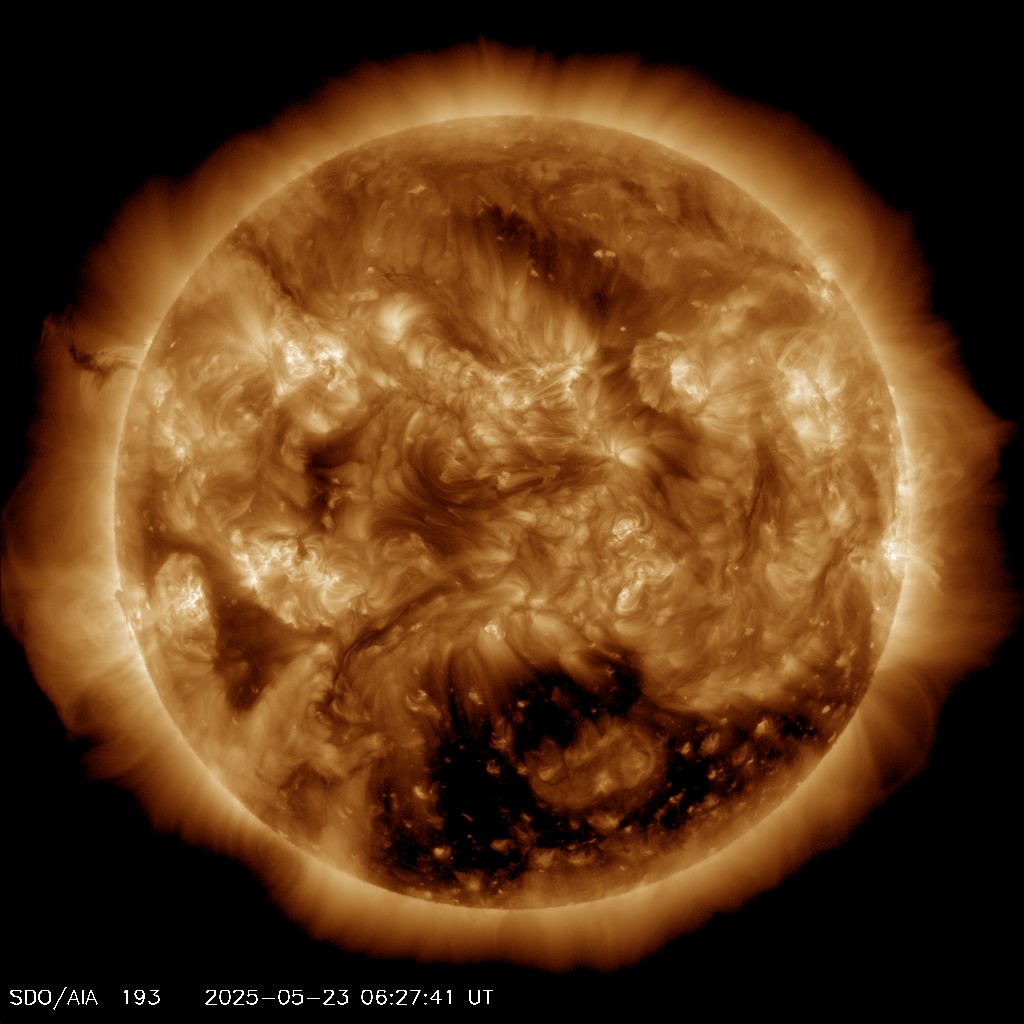
| Extreme-ultraviolet Sun, AIA 193 Å (latest) | Courtesy of NASA/SDO and the AIA, EVE, and HMI science teams, from sdo.gsfc.nasa.gov. Live viewer: sdo.gsfc.nasa.gov/data | Public domain (U.S. government work; SDO data use) |
Data
- NOAA Space Weather Prediction Center (SWPC): planetary K-index, solar wind, NOAA scales, alerts, GOES X-ray flares and solar-cycle indices from services.swpc.noaa.gov. U.S. government work, public domain in the United States. We credit NOAA SWPC but are not affiliated with or endorsed by NOAA.
- NASA Community Coordinated Modeling Center (CCMC) DONKI: CME and flare event records, via the DONKI web service. Credit: NASA CCMC and the Moon to Mars Space Weather Analysis Office. Not affiliated with or endorsed by NASA.
- Sunspot numbers: the smoothed sunspot values in NOAA's solar-cycle feed are based on the international sunspot number from WDC-SILSO, Royal Observatory of Belgium.
- Sky events (Eclipses, meteor showers & sky events): eclipse data from NASA GSFC eclipse predictions by Fred Espenak (cross-checked with EclipseWise); meteor shower data from the IMO Meteor Shower Calendar (ed. J. Rendtel); Moon and planet events computed with Skyfield and the JPL DE440 ephemeris (NASA/JPL).
- Bibliographic metadata: paper titles and DOIs were checked against Crossref and publisher pages.
Text
All guide and claim text is original to Solar Evidence. Sources are cited and linked, not reproduced.
Fonts and code
The site uses your device's system fonts (no web fonts are loaded) and no third-party scripts, trackers or ad code.